
USD/INR surges above 94 as INR plummets amid consistent foreign outflows
- The Indian Rupee slides to a fresh all-time low at 94.23 against the US Dollar.
- Consistent foreign outflows from the Indian stock market have dragged the Indian currency.
- The Fed is expected to hold interest rates steady for longer.
The Indian Rupee (INR) extends its downfall against the US Dollar (USD) on Friday after a holiday the previous day. The USD/INR pair rises to near 94.23, the lifetime high, as the Indian currency continues to face significant pressure from consistent foreign outflows from the Indian stock market and higher oil prices amid conflicts in the Middle East, and a decent recovery move in the US Dollar.
Consistent FIIs selling hits Indian Rupee badly
Overseas investors have been consistently dumping their stake from the Indian stock market as higher oil prices due to the joint assault by the US and Israel against Iran have prompted uncertainty over earnings expectations of the Nifty 50 for the fourth quarter of FY 2025-26.
Theoretically, companies bear the burden of increased input costs by allowing a hit on profit margins or passing on to consumers, which both result in a deviation between projected earnings and actual numbers.
So far in March, Foreign Institutional Investors (FIIs) have remained net sellers on all trading days and offloaded their stake worth Rs. 81,262.5 crore.
US Dollar recovers after Thursday's sell-off
During the press time, the US Dollar Index (DXY), which tracks the Greenback’s value against six major currencies, trades almost 0.3% higher to near 99.45. The USD Index recovers from Thursday’s low of around 99.00 amid the speculation that the Federal Reserve (Fed) will hold interest rates at their current levels by the year-end.
According to the CME FedWatch tool, the odds of the Fed holding interest rates steady or above the current range of 3.50%-3.75% in the December meeting are 80%, double than 40% seen a week ago. Speculation that the Fed will not cut interest rates the entire year has been intensified by de-anchoring inflation expectations globally amid higher oil prices.
On Thursday, the US Dollar declined over 1% after comments from several global central banks signaled they would also favor tight monetary conditions amid accelerating inflation projections, which diminished fears of likely policy divergence between the Fed and other central banks.
Technical Analysis: USD/INR surpasses 94.00
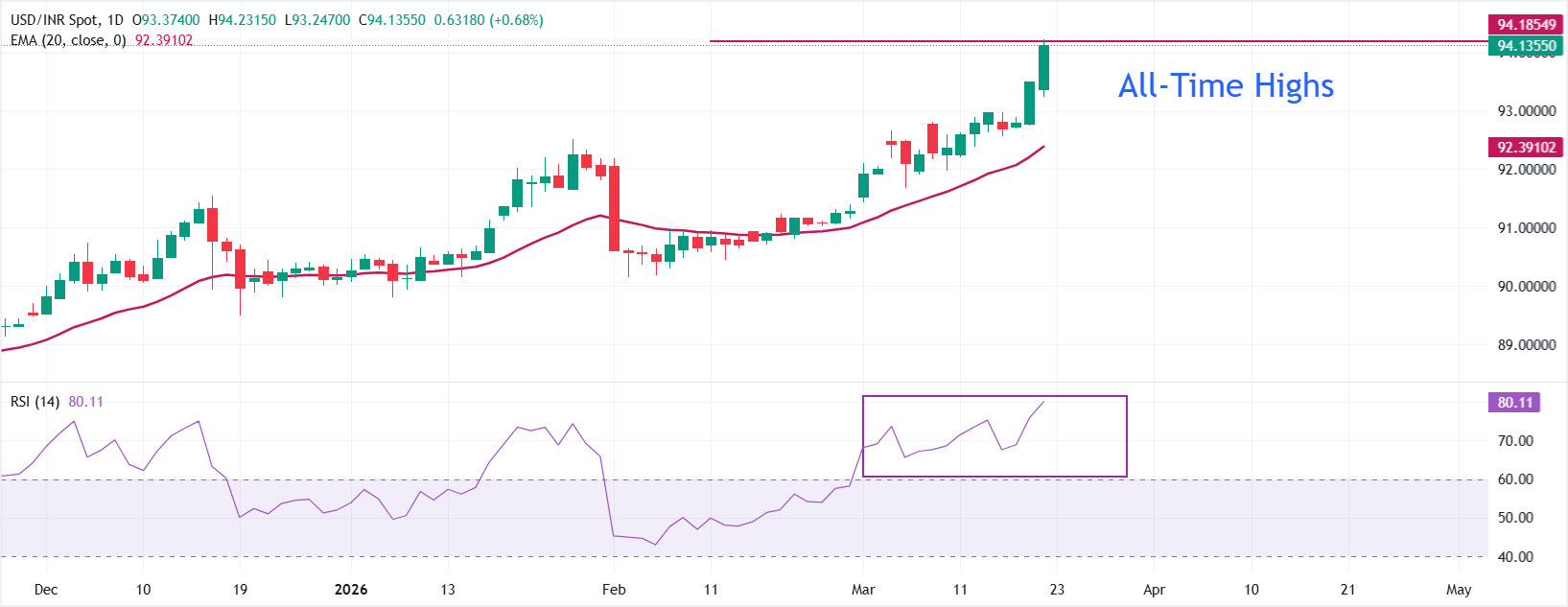
USD/INR jumps to near 94.23 on Friday. The near-term bias is bullish as the price extends above the rising 20-day Exponential Moving Average (EMA), confirming a strong uptrend. The recent surge has stretched the distance from the 20-day EMA, showing strong buying pressure rather than a gradual grind higher.
The 14-day Relative Strength Index (RSI) at 80 signals overbought momentum after a series of higher closes from mid-range readings, indicating trend strength but also a mature leg within this upswing.
Initial resistance sits near the psychological 95.00 level, with buyers maintaining control. On the downside, immediate support lies near the March 13 high around 93.00, close to the prior breakout region and above the 20-day EMA near 92.35, where pullbacks would test trend integrity. A daily close below 92.30 would weaken the bullish structure and open the way toward secondary support at 91.80, while holding above it keeps focus on resistance retests.
(The technical analysis of this story was written with the help of an AI tool.)
(This story was corrected at 10:25 GMT to say in the first bullet point that The Indian Rupee slides to a fresh all-time low at 94.23, and not 93.90.)
Indian economy FAQs
The Indian economy has averaged a growth rate of 6.13% between 2006 and 2023, which makes it one of the fastest growing in the world. India’s high growth has attracted a lot of foreign investment. This includes Foreign Direct Investment (FDI) into physical projects and Foreign Indirect Investment (FII) by foreign funds into Indian financial markets. The greater the level of investment, the higher the demand for the Rupee (INR). Fluctuations in Dollar-demand from Indian importers also impact INR.
India has to import a great deal of its Oil and gasoline so the price of Oil can have a direct impact on the Rupee. Oil is mostly traded in US Dollars (USD) on international markets so if the price of Oil rises, aggregate demand for USD increases and Indian importers have to sell more Rupees to meet that demand, which is depreciative for the Rupee.
Inflation has a complex effect on the Rupee. Ultimately it indicates an increase in money supply which reduces the Rupee’s overall value. Yet if it rises above the Reserve Bank of India’s (RBI) 4% target, the RBI will raise interest rates to bring it down by reducing credit. Higher interest rates, especially real rates (the difference between interest rates and inflation) strengthen the Rupee. They make India a more profitable place for international investors to park their money. A fall in inflation can be supportive of the Rupee. At the same time lower interest rates can have a depreciatory effect on the Rupee.
India has run a trade deficit for most of its recent history, indicating its imports outweigh its exports. Since the majority of international trade takes place in US Dollars, there are times – due to seasonal demand or order glut – where the high volume of imports leads to significant US Dollar- demand. During these periods the Rupee can weaken as it is heavily sold to meet the demand for Dollars. When markets experience increased volatility, the demand for US Dollars can also shoot up with a similarly negative effect on the Rupee.