
USD/INR rallies further amid higher oil prices, FIIs selling pressure
- The Indian Rupee weakens further against the US Dollar amid higher oil prices.
- The selling pressure from FIIs in the Indian stock market has increased.
- Investors expect the Fed to hold interest rates steady next week.
The Indian Rupee (INR) slides further against the US Dollar (USD) on Friday, extending its losing streak for the fifth trading day. The USD/INR pair trades firmly near the weekly high of 94.38 as the Indian currency continues to underperform in the wake of higher energy prices and the resumption of significant foreign selling in the Indian stock market.
In addition to the above-mentioned headwinds for the Indian Rupee, the upbeat US Dollar is also supporting the USD/INR pair. As of writing, the US Dollar Index (DXY), which tracks the Greenback’s value against six major currencies, trades firmly near the 10-day high of around 99.00.
Oil prices remain elevated amid fears of prolonged Hormuz closure
Higher oil prices amid the suspension of oil flows through the Strait of Hormuz, a vital passage to almost 20% of global energy supply, by Iran as part of retaliation against the United States (US), have undermined the Indian Rupee.
During the press time, the WTI Oil price holds onto weekly gains at around $95.00. Currencies from economies, such as India, which rely heavily on oil imports to meet their energy needs, underperform in a high oil price environment.
Investors doubt that the Hormuz will open soon, as Iran has not yet agreed to resume peace talks with the US, blaming Washington for the continuous blockade of Iranian sea ports.
Meanwhile, a report from CNN has shown that US military officials are developing new plans to target Iran’s capabilities in the Strait of Hormuz in the event the current ceasefire with Iran fails.
FIIs resume offloading stake in Indian stock market
So far this week, FIIs have remained net sellers in all four trading days and have offloaded their stake worth Rs. 8,311.99 crore. Foreign investors have resumed selling after a brief pause in the last three trading days of the previous week. Elevated oil prices have dimmed the interest of overseas investors in the Indian stock market amid concerns over India Inc.'s forward earnings and the expectations that the government would trim its capital expenditure to offset obligations towards rising energy prices.
Fed's policy comes into focus
Going forward, the major trigger for global markets will be the monetary policy announcement by the Federal Reserve (Fed) on Wednesday. The Fed is widely anticipated to leave interest rates unchanged in the range of 3.50%-3.75% and warn of upside inflation risks in the wake of higher energy prices. Investors will pay close attention to cues regarding whether the Fed plans to hike interest rates anytime this year.
Technical Analysis: USD/INR extends winning streak
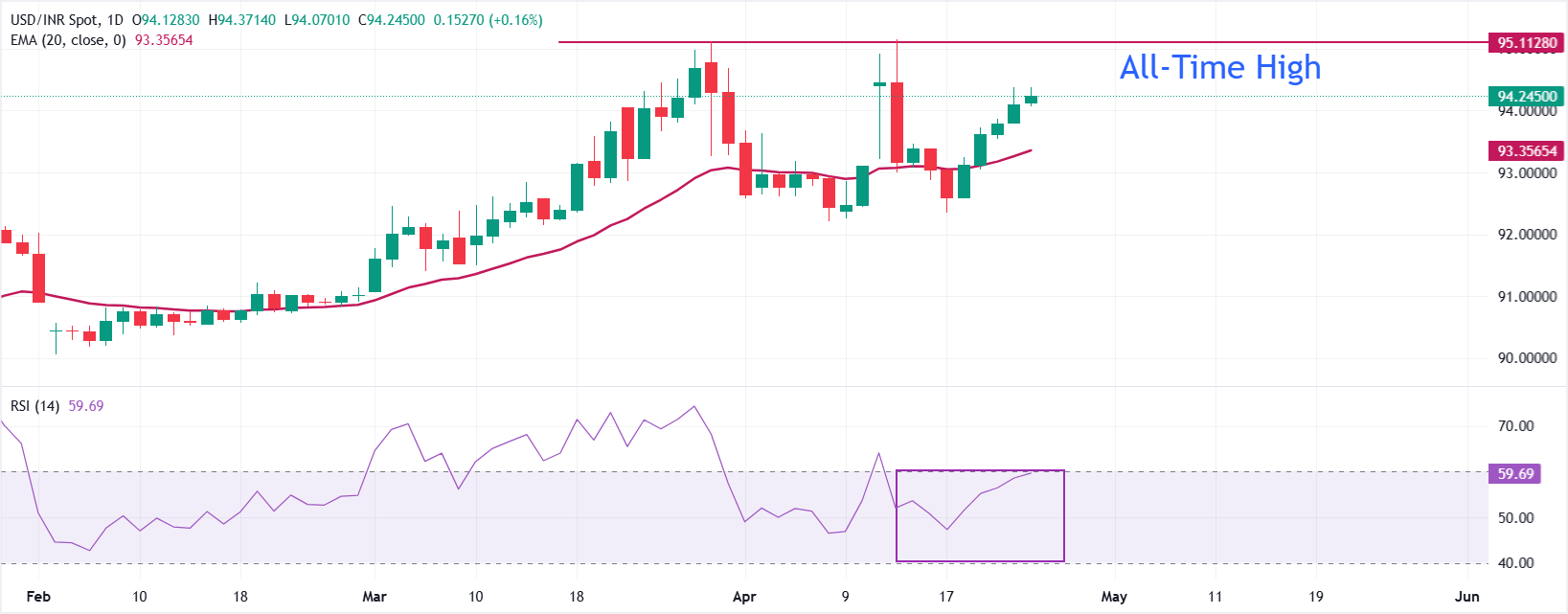
USD/INR trades higher above 94.20 at the press time, holding a constructive bullish bias as spot remains firmly above the 20-period Exponential Moving Average (EMA) at 93.35. The positioning over this short-term trend line suggests buyers retain control, while the Relative Strength Index (14) at 59 shows positive but not overstretched momentum, hinting that the advance could extend as long as the pair defends its underlying supports.
On the downside, initial support is seen at the 20-period EMA at 93.35, which underpins the current structure and is likely to attract dip buyers on shallow pullbacks. A daily close below this dynamic floor would weaken the immediate bullish tone and expose deeper retracements, whereas holding above it keeps the door open for further gains toward the all-time high at around 95.20.
(The technical analysis of this story was written with the help of an AI tool.)
Fed FAQs
Monetary policy in the US is shaped by the Federal Reserve (Fed). The Fed has two mandates: to achieve price stability and foster full employment. Its primary tool to achieve these goals is by adjusting interest rates. When prices are rising too quickly and inflation is above the Fed’s 2% target, it raises interest rates, increasing borrowing costs throughout the economy. This results in a stronger US Dollar (USD) as it makes the US a more attractive place for international investors to park their money. When inflation falls below 2% or the Unemployment Rate is too high, the Fed may lower interest rates to encourage borrowing, which weighs on the Greenback.
The Federal Reserve (Fed) holds eight policy meetings a year, where the Federal Open Market Committee (FOMC) assesses economic conditions and makes monetary policy decisions. The FOMC is attended by twelve Fed officials – the seven members of the Board of Governors, the president of the Federal Reserve Bank of New York, and four of the remaining eleven regional Reserve Bank presidents, who serve one-year terms on a rotating basis.
In extreme situations, the Federal Reserve may resort to a policy named Quantitative Easing (QE). QE is the process by which the Fed substantially increases the flow of credit in a stuck financial system. It is a non-standard policy measure used during crises or when inflation is extremely low. It was the Fed’s weapon of choice during the Great Financial Crisis in 2008. It involves the Fed printing more Dollars and using them to buy high grade bonds from financial institutions. QE usually weakens the US Dollar.
Quantitative tightening (QT) is the reverse process of QE, whereby the Federal Reserve stops buying bonds from financial institutions and does not reinvest the principal from the bonds it holds maturing, to purchase new bonds. It is usually positive for the value of the US Dollar.