
USD/INR falls on potential second round of US-Iran talks
- The Indian Rupee opens positively against the US Dollar on hopes of a US-Iran permanent ceasefire.
- Negotiations between the US and Iran are expected to resume this week.
- The FIIs' selling pressure has cooled down since the US-Iran two-week ceasefire announcement.
The Indian Rupee (INR) gains against the US Dollar (USD) on Wednesday after a holiday the previous day due to Dr. Baba Saheb Ambedkar Jayanti. The USD/INR pair falls to near 93.20 as a sharp decline in the oil price and upbeat market sentiment due to growing expectations that the United States (US) and Iran could reach a permanent ceasefire soon have improved the Indian Rupee’s appeal.
Trump expects war with Iran to be very close to being over
Earlier in the day, US President Donald Trump said in an interview with Fox Business, "I think it’s close to over, yeah. I view it as very close to being over," when asked about how long the war with Iran will remain.
US President Trump also said to The New York Post on Tuesday that negotiation teams from Washington and Tehran could resume talks in Pakistan in the next two days.
Positive commentary from US President Trump over a permanent truce with Iran, despite the first round of talks ending without a breakthrough, has fuelled market sentiment, diminished the appeal of safe-haven assets, and weighed on the oil price.
As of writing, the US Dollar Index (DXY), which tracks the Greenback’s value against six major currencies, ticks higher to near 98.15, but is still close to its almost seven-week low of 98.00.
WTI Oil price slides below $90.00 on hopes that the US-Iran truce would ease supply crisis; however, market experts worry that supply constraints will remain for longer due to significant damage to energy infrastructure in the Middle East.
The appeal of currencies from economies, such as India, which rely heavily on oil imports to meet their energy needs, improves when oil prices start declining after a healthy run.
The pace of FIIs selling cools down
Since the announcement of the two-week ceasefire between the US and Iran, the amount of daily selling by overseas investors in the Indian stock market has cooled down. So far in April, Foreign Institutional Investors (FIIs) have remained net sellers in seven out of eight trading days and have pared their stake worth Rs. 40,955.81 crore. However, the stake offloaded since the two-week truce announcement on April 7 midnight was Rs. 5,834.25 crore, one-fifth of the amount recorded in the first week of this month.
On the economic data front, the WPI Inflation data for March has arrived higher at 3.88% Year-on-Year (YoY) against estimates of 3% and the previous reading of 2.13%.
Technical Analysis: USD/INR will likely fall towards 92.20 if it fails to hold 20-day EMA
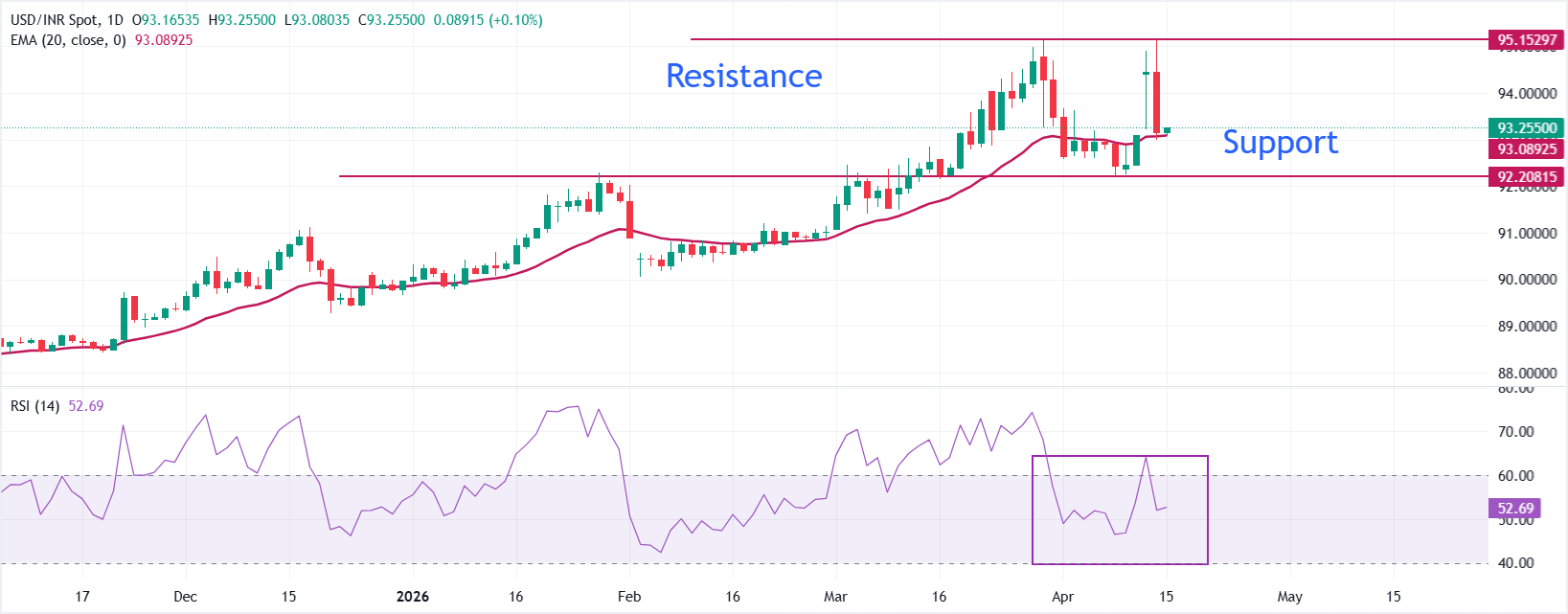
USD/INR trades lower at around 93.25 on Wednesday. The pair holds a modest bullish bias as spot remains above the 20-day Exponential Moving Average (EMA) at around 93.10. The recovery from last week’s trough is underpinned by this dynamic support, while the 14-day Relative Strength Index around 52.7 suggests neutral-to-slightly positive momentum rather than an overstretched advance.
On the downside, the 20-day EMA at 93.09 is the first key support to watch; a daily close below this level would weaken the constructive tone and open the door to a deeper correction toward the January high of 92.29. Looking up, the pair could advance towards the all-time high of 95.15 if it manages to recover sustainably above the 94.00 mark.
(The technical analysis of this story was written with the help of an AI tool.)
Indian economy FAQs
The Indian economy has averaged a growth rate of 6.13% between 2006 and 2023, which makes it one of the fastest growing in the world. India’s high growth has attracted a lot of foreign investment. This includes Foreign Direct Investment (FDI) into physical projects and Foreign Indirect Investment (FII) by foreign funds into Indian financial markets. The greater the level of investment, the higher the demand for the Rupee (INR). Fluctuations in Dollar-demand from Indian importers also impact INR.
India has to import a great deal of its Oil and gasoline so the price of Oil can have a direct impact on the Rupee. Oil is mostly traded in US Dollars (USD) on international markets so if the price of Oil rises, aggregate demand for USD increases and Indian importers have to sell more Rupees to meet that demand, which is depreciative for the Rupee.
Inflation has a complex effect on the Rupee. Ultimately it indicates an increase in money supply which reduces the Rupee’s overall value. Yet if it rises above the Reserve Bank of India’s (RBI) 4% target, the RBI will raise interest rates to bring it down by reducing credit. Higher interest rates, especially real rates (the difference between interest rates and inflation) strengthen the Rupee. They make India a more profitable place for international investors to park their money. A fall in inflation can be supportive of the Rupee. At the same time lower interest rates can have a depreciatory effect on the Rupee.
India has run a trade deficit for most of its recent history, indicating its imports outweigh its exports. Since the majority of international trade takes place in US Dollars, there are times – due to seasonal demand or order glut – where the high volume of imports leads to significant US Dollar- demand. During these periods the Rupee can weaken as it is heavily sold to meet the demand for Dollars. When markets experience increased volatility, the demand for US Dollars can also shoot up with a similarly negative effect on the Rupee.