
USD/INR corrects further as US-Iran optimism pushes oil prices lower
- The Indian Rupee bounces back against the US Dollar, with the USD/INR pair sliding to near 94.15.
- US-Iran negotiations will likely make a breakthrough in the coming hours.
- FIIs remain in the sellers’ mode despite US-Iran truce optimism.
The Indian Rupee (INR) recovers early losses and turns positive against the US Dollar (USD) on Thursday. The USD/INR pair slides to near 94.15 amid the renewed selling pressure in the oil price, following headlines that there could be a breakthrough towards the reopening of the Strait of Hormuz, a vital passage to almost 20% of global energy supply, soon.
Oil price slumps amid US-Iran optimism
The Indian Rupee has attracted significant bids against the US Dollar as the oil price plummets. As of writing, the WTI Oil price is down almost 3% to near $90.00. During the European trade, Al-Hadath, sister channel to Al Arabiya, stated on its X handle that intense communications between the United States (USD) and Iran are ongoing to gradually reopen the Strait of Hormuz, according to sources. The post also stated that there could be a “breakthrough in US-Iran peace talks in the coming hours for ships stranded in the Strait”.
Currencies from economies, such as India, that rely on oil imports to meet their energy needs appreciate when oil prices start declining.
Market participants were already confident regarding the US-Iran deal. On Wednesday, US President Donald Trump said, "They [Iran] want to make a deal. We've had very good talks over the last 24 hours, and it's very possible that we'll make a deal up there," Trump said, adding: "I think we won," the BBC reported.
Growth outlook concerns dampen FIIs' sentiment
Despite the dominance of risk flows in global markets amid optimism over the US-Iran peace deal, Foreign Institutional Investors (FIIs) continue to dump their stake in the Indian stock market. So far in May, FIIs have remained net sellers in two of the three trading days and have offloaded their stake worth Rs. 6,620.86 crore.
Increased concerns over India’s growth and inflation outlook amid expectations that energy prices will remain higher for a prolonged period, even if the US and Iran reach a peace plan today, are hurting the sentiment of foreign investors toward the Indian stock market.
US Dollar faces pressure
Weakness in the US Dollar, following positive remarks regarding the US-Iran negotiations, has also weighed on the US Dollar. At press time, the US Dollar Index (DXY), which tracks the Greenback’s value against six major currencies, trades 0.12% lower at around 97.90 and is close to its over two-month low of 97.62 posted on Wednesday.
Going forward, investors will pay close attention to the US Nonfarm Payrolls (NFP) data for April, which will be released on Friday, to get fresh cues on the Federal Reserve’s (Fed) monetary policy outlook. The employment report is expected to show that the economy created 60K fresh jobs.
Technical Analysis: USD/INR extends decline to near 20-day EMA
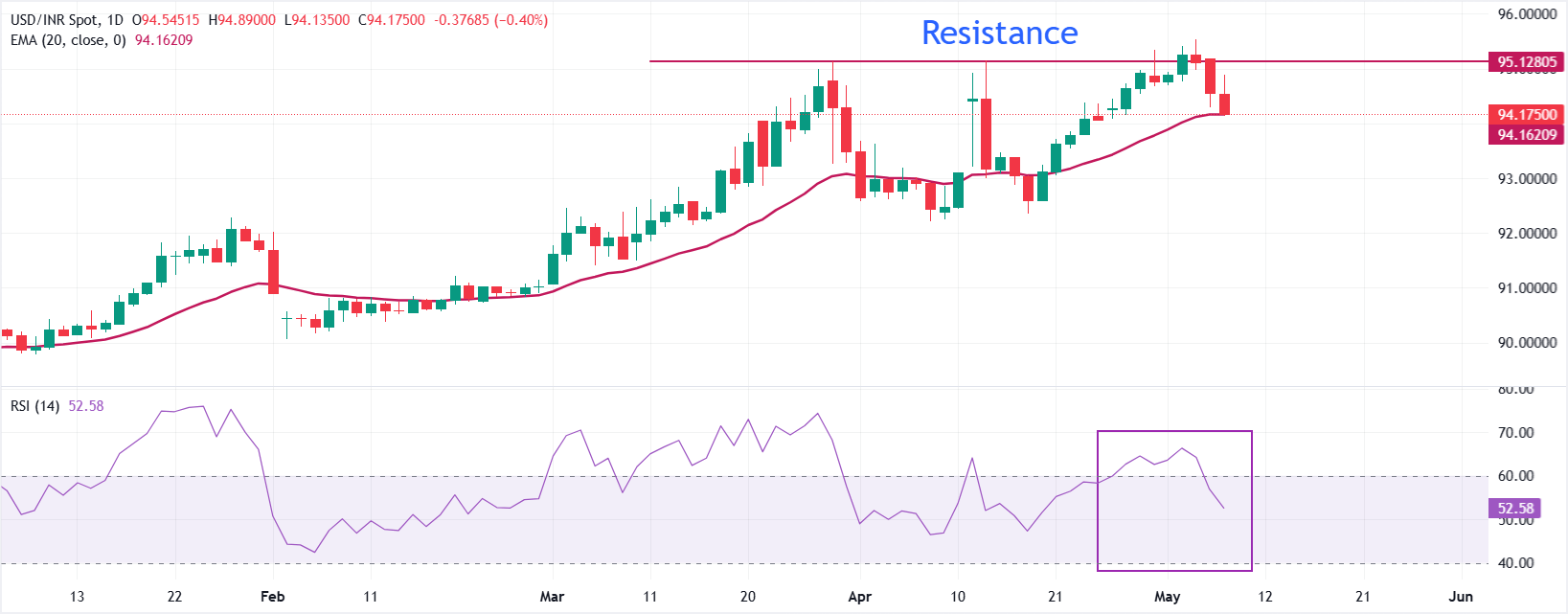
USD/INR trades lower at around 94.15 at the time of writing. The near-term trend of the pair has become uncertain as it has corrected to near the 20-day exponential moving average (EMA), which is at 94.17.
The Relative Strength Index (RSI) has eased to near 52.60 from overbought territory and now sits in neutral ground, suggesting the uptrend is pausing rather than reversing.
On the downside, the pair could slide toward prior breakout areas in the 93s if it fails to hold the 20-day EMA around 94.17. As long as USD/INR defends this moving average on a closing basis, dips are likely to find buyers, leaving the broader topside bias intact even as momentum cools. Looking up, the all-time high of 95.53 posted on Tuesday will remain a barrier.
(The technical analysis of this story was written with the help of an AI tool.)
Economic Indicator
Nonfarm Payrolls
The Nonfarm Payrolls release presents the number of new jobs created in the US during the previous month in all non-agricultural businesses; it is released by the US Bureau of Labor Statistics (BLS). The monthly changes in payrolls can be extremely volatile. The number is also subject to strong reviews, which can also trigger volatility in the Forex board. Generally speaking, a high reading is seen as bullish for the US Dollar (USD), while a low reading is seen as bearish, although previous months' reviews and the Unemployment Rate are as relevant as the headline figure. The market's reaction, therefore, depends on how the market assesses all the data contained in the BLS report as a whole.
Read more.Next release: Fri May 08, 2026 12:30
Frequency: Monthly
Consensus: 60K
Previous: 178K
Source: US Bureau of Labor Statistics
America’s monthly jobs report is considered the most important economic indicator for forex traders. Released on the first Friday following the reported month, the change in the number of positions is closely correlated with the overall performance of the economy and is monitored by policymakers. Full employment is one of the Federal Reserve’s mandates and it considers developments in the labor market when setting its policies, thus impacting currencies. Despite several leading indicators shaping estimates, Nonfarm Payrolls tend to surprise markets and trigger substantial volatility. Actual figures beating the consensus tend to be USD bullish.