
Pound Sterling trades subduedly while focus shifts to Fed's monetary policy
- The Pound Sterling trades broadly calm against its major peers at the start of a week featuring the Fed interest-rate decision.
- Investors expect both the Fed and the BoE to cut interest rates by 25 bps this month.
- The Fed might call for a pause after a rate cut on Wednesday as inflation remains well above the 2% target.
The Pound Sterling (GBP) trades slightly lower against its major currency peers at the start of the week, hovering at around 1.3320 against the US Dollar (USD). In a week in which the United Kingdom (UK) economic calendar is light, the British currency is expected to be influenced by global events and market expectations for the Bank of England’s (BoE) monetary policy outlook.
Traders are confident that the BoE will cut interest rates in the policy meeting next week amid weak UK labor market conditions and signs of a slowdown in inflation . The job market data for the three months ending in September showed that the Unemployment Rate rose to 5%. Meanwhile, the headline Consumer Price Index (CPI) report for October showed that inflation stood at 3.6% on an annual basis, the lowest level in four months.
For more cues on the monetary policy outlook, investors will focus on the speech by Bank of England (BoE) external member Alan Taylor, which is scheduled at 14:30 GMT.
Pound Sterling Price Today
The table below shows the percentage change of British Pound (GBP) against listed major currencies today. British Pound was the weakest against the New Zealand Dollar.
| USD | EUR | GBP | JPY | CAD | AUD | NZD | CHF | |
|---|---|---|---|---|---|---|---|---|
| USD | -0.08% | 0.09% | 0.09% | -0.03% | 0.00% | -0.20% | -0.05% | |
| EUR | 0.08% | 0.17% | 0.14% | 0.02% | 0.09% | -0.12% | 0.04% | |
| GBP | -0.09% | -0.17% | 0.00% | -0.15% | -0.09% | -0.30% | -0.14% | |
| JPY | -0.09% | -0.14% | 0.00% | -0.14% | -0.08% | -0.29% | -0.13% | |
| CAD | 0.03% | -0.02% | 0.15% | 0.14% | 0.07% | -0.13% | 0.02% | |
| AUD | -0.01% | -0.09% | 0.09% | 0.08% | -0.07% | -0.21% | -0.05% | |
| NZD | 0.20% | 0.12% | 0.30% | 0.29% | 0.13% | 0.21% | 0.16% | |
| CHF | 0.05% | -0.04% | 0.14% | 0.13% | -0.02% | 0.05% | -0.16% |
The heat map shows percentage changes of major currencies against each other. The base currency is picked from the left column, while the quote currency is picked from the top row. For example, if you pick the British Pound from the left column and move along the horizontal line to the US Dollar, the percentage change displayed in the box will represent GBP (base)/USD (quote).
Daily digest market movers: Fed looks set to cut interest rates on Wednesday
- The Pound Sterling consolidates against the US Dollar (USD) around 1.3320 during the European trading session on Monday. The GBP/USD pair turns sideways after posting an over a month high at around 1.3385 last week, while the US Dollar trades cautiously ahead of the Federal Reserve’s (Fed) monetary policy announcement on Wednesday.
- At the time of writing, the US Dollar Index (DXY), which tracks the Greenback’s value against six major currencies, struggles to hold its over five-week low of 98.75 posted on Thursday.
- The CME FedWatch tool shows that the probability of the Fed cutting interest rates by 25 basis points (bps) to 3.50%-3.75% on Wednesday's policy meeting is 87%.
- The major trigger behind the firm Fed dovish expectations is weakening job market conditions. In late November, New York Fed Bank President John Williams also warned of slower economic growth and weak labour demand, while supporting the need for more interest-rate cuts. "Economic growth has slowed and the labor market gradually cooled," Williams said, adding that "there is room for a further adjustment in the near term.”
- With traders remaining confident that the Fed will cut interest rates on Wednesday, the major trigger for the US Dollar will be guidance on the monetary policy outlook. Federal Open Market Committee (FOMC) members are expected to support holding interest rates steady in early 2026 as inflationary pressures have remained well above the 2% target for months.
Technical Analysis: GBP/USD sees more upside above 1.3400
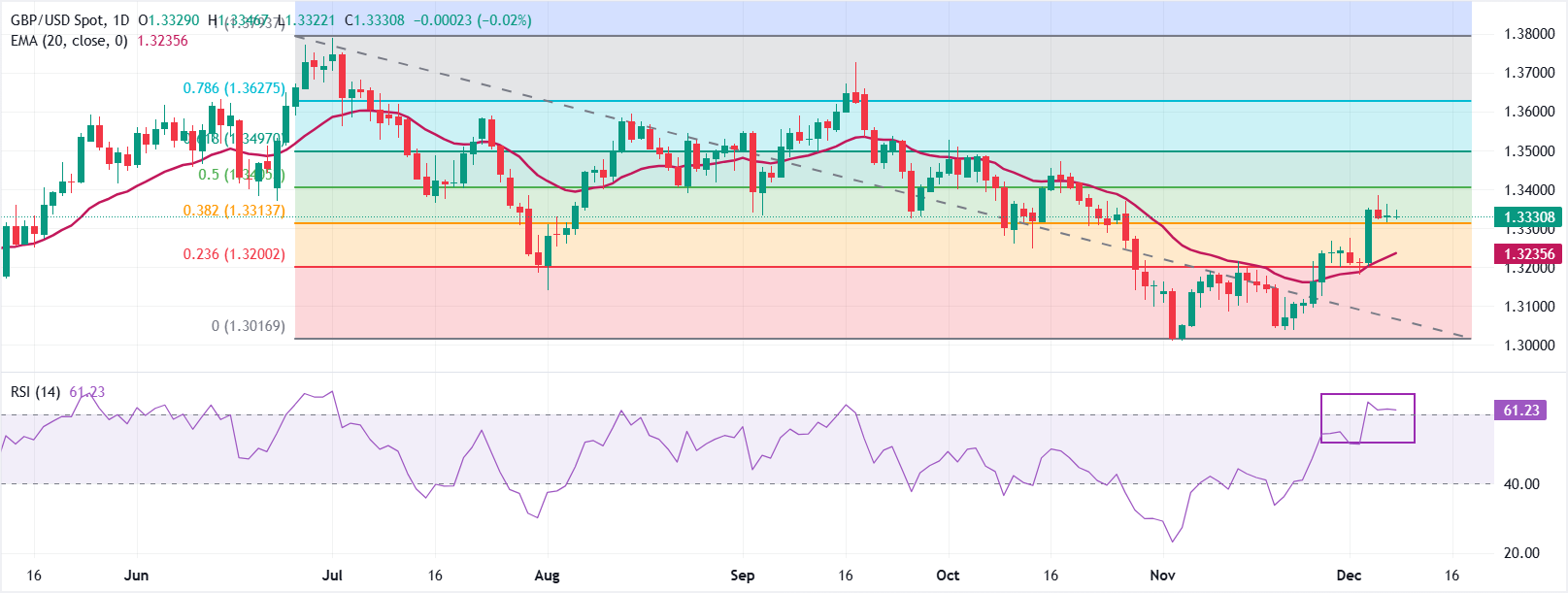
The Pound Sterling trades flat around 1.3320 against the US Dollar on Monday. The pair holds above a rising 20-day Exponential Moving Average (EMA) at 1.3227, maintaining a positive near-term bias. The 20-day EMA has sloped higher in recent sessions, and dips remain shallow.
The 14-day Relative Strength Index (RSI) at around 60 reflects bullish momentum.
Momentum remains supportive as price stays above the rising 20-day EMA. A daily close above the 50% Fibonacci retracement at 1.3402 would reinforce the bullish tone and open room towards the October 17 high of 1.3471. Conversely, failure to breach that barrier would keep the pair consolidating, with pullbacks leaning toward the 38.2% Fibonacci area and trend support at 1.3310.
Fed FAQs
Monetary policy in the US is shaped by the Federal Reserve (Fed). The Fed has two mandates: to achieve price stability and foster full employment. Its primary tool to achieve these goals is by adjusting interest rates. When prices are rising too quickly and inflation is above the Fed’s 2% target, it raises interest rates, increasing borrowing costs throughout the economy. This results in a stronger US Dollar (USD) as it makes the US a more attractive place for international investors to park their money. When inflation falls below 2% or the Unemployment Rate is too high, the Fed may lower interest rates to encourage borrowing, which weighs on the Greenback.
The Federal Reserve (Fed) holds eight policy meetings a year, where the Federal Open Market Committee (FOMC) assesses economic conditions and makes monetary policy decisions. The FOMC is attended by twelve Fed officials – the seven members of the Board of Governors, the president of the Federal Reserve Bank of New York, and four of the remaining eleven regional Reserve Bank presidents, who serve one-year terms on a rotating basis.
In extreme situations, the Federal Reserve may resort to a policy named Quantitative Easing (QE). QE is the process by which the Fed substantially increases the flow of credit in a stuck financial system. It is a non-standard policy measure used during crises or when inflation is extremely low. It was the Fed’s weapon of choice during the Great Financial Crisis in 2008. It involves the Fed printing more Dollars and using them to buy high grade bonds from financial institutions. QE usually weakens the US Dollar.
Quantitative tightening (QT) is the reverse process of QE, whereby the Federal Reserve stops buying bonds from financial institutions and does not reinvest the principal from the bonds it holds maturing, to purchase new bonds. It is usually positive for the value of the US Dollar.