
Pound Sterling outperforms Greenback ahead of flash US Q3 GDP data
- The Pound Sterling rises against its major currency peers as the BoE is expected to follow a slower monetary easing path.
- Investors wait for the BoE to cut interest rates at least once in the first half of 2026.
- The major highlight of Tuesday will be the flash US Q3 GDP data.
The Pound Sterling (GBP) revisits the almost 12-week high to near 1.3500 against the US Dollar (USD) during European trading hours on Tuesday. The GBP/USD pair gains as the US Dollar faces intense selling pressure, with traders remaining confident that the Federal Reserve (Fed) will deliver at least two interest rate cuts in 2026.
At the time of writing, the US Dollar Index (DXY), which tracks the Greenback’s value against six major currencies, trades 0.16% lower to near 98.00. The DXY is not very far from revisiting the 97.87 low posted last week.
According to the CME FedWatch tool, the odds of the Fed reducing interest rates by at least 50 bps in 2026 are 73.8%. However, the Fed’s dot plot published two weeks ago showed that policymakers collectively see the Federal Fund Rate heading to 3.4% by the end of 2026, indicating that there won’t be more than one interest rate cut.
In the press conference after the central bank's monetary policy decision on December 10, Fed Chair Jerome Powell also stated that the bar for another interest rate cut is very high.
Fed dovish speculation has intensified due to weakening United States (US) job market conditions, and expectations that the impact of tariffs on inflation was a one-off.
US Dollar Price Today
The table below shows the percentage change of US Dollar (USD) against listed major currencies today. US Dollar was the weakest against the New Zealand Dollar.
| USD | EUR | GBP | JPY | CAD | AUD | NZD | CHF | |
|---|---|---|---|---|---|---|---|---|
| USD | -0.38% | -0.42% | -0.70% | -0.38% | -0.62% | -0.81% | -0.60% | |
| EUR | 0.38% | -0.05% | -0.33% | -0.00% | -0.25% | -0.45% | -0.22% | |
| GBP | 0.42% | 0.05% | -0.29% | 0.04% | -0.20% | -0.39% | -0.17% | |
| JPY | 0.70% | 0.33% | 0.29% | 0.33% | 0.11% | -0.13% | 0.14% | |
| CAD | 0.38% | 0.00% | -0.04% | -0.33% | -0.22% | -0.44% | -0.20% | |
| AUD | 0.62% | 0.25% | 0.20% | -0.11% | 0.22% | -0.19% | 0.03% | |
| NZD | 0.81% | 0.45% | 0.39% | 0.13% | 0.44% | 0.19% | 0.22% | |
| CHF | 0.60% | 0.22% | 0.17% | -0.14% | 0.20% | -0.03% | -0.22% |
The heat map shows percentage changes of major currencies against each other. The base currency is picked from the left column, while the quote currency is picked from the top row. For example, if you pick the US Dollar from the left column and move along the horizontal line to the Japanese Yen, the percentage change displayed in the box will represent USD (base)/JPY (quote).
Daily digest market movers: Few BoE officials warn of upbeats wage growth outlook
- The Pound Sterling trades broadly higher against its major peers amid expectations that the Bank of England (BoE) will follow a gradual monetary easing path in 2026.
- Last week, the BoE reduced interest rates by 25 basis points (bps) to 3.75%, with a narrow majority vote and guided that “rates are on a gradual path downward”. Four of nine members-led Monetary Policy Committee (MPC) dissented on the interest rate cut amid upbeat wage growth outlook, a scenario that could keep inflation persistently higher than the central bank’s target of 2%.
- Though the United Kingdom (UK) headline inflation has consistently cooled down in the last two months on an annualized basis to 3.2% after peaking in the July-September period at 3.8%, it is still significantly higher than the central bank’s target of 2%.
- In the press conference, following the BoE’s interest rate decision, Governor Andrew Bailey assured that inflation could return close to the 2% target by the first half of 2026.
- According to a report from Reuters, traders expect the BoE to deliver at least one 25 bps interest rate cut in the first half of next year.
- In Tuesday’s session, the GBP/USD pair will be influenced by the preliminary US Q3 Gross Domestic Product (GDP) data, which will be published at 13:30 GMT.
- The US economy is expected to have expanded at an annualized pace of 3.2%, slower than 3.8% in the second quarter this year. Signs of moderating US GDP growth would prompt expectations for further interest rate cuts by the Fed in the near term.
Technical Analysis: GBP/USD holds key 20-day EMA
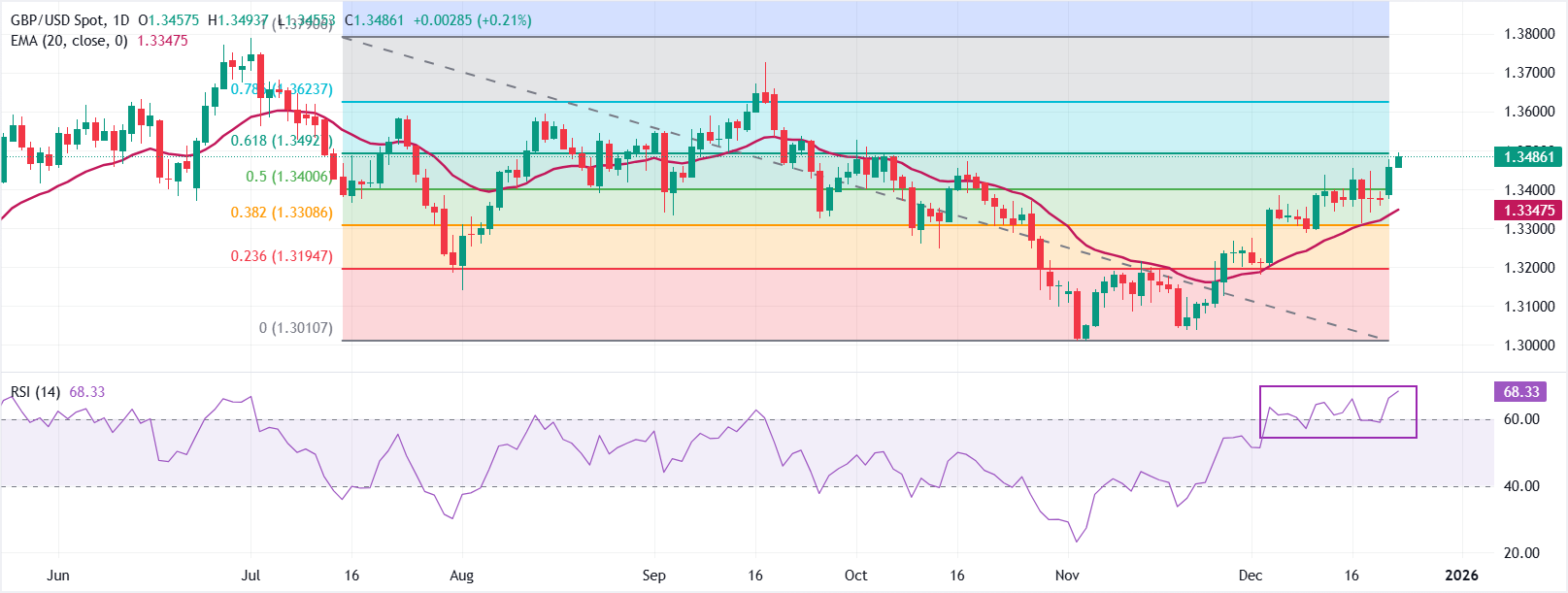
GBP/USD jumps to near 1.3500 on Tuesday. The GBP/USD pair extends its advance above the rising 20-day EMA, which sits at 1.3348 and supports a bullish bias. The 20-day EMA’s upward slope has steepened, underscoring firm demand.
The 14-day Relative Strength Index (RSI) at 68 is near the overbought zone on the daily chart, confirming strong momentum that could stretch further. Measured from the 1.3791 high to the 1.3011 low, the 61.8% Fibonacci retracement at 1.3493 caps the move. A break of this level would open the path toward the 78.6% Fibonacci retracement at 1.3624.
On the contrary, a failure to clear the nearby retracement barrier could prompt a pullback toward the moving average, while sustained strength would preserve the upward tone.
(The technical analysis of this story was written with the help of an AI tool.)
BoE FAQs
The Bank of England (BoE) decides monetary policy for the United Kingdom. Its primary goal is to achieve ‘price stability’, or a steady inflation rate of 2%. Its tool for achieving this is via the adjustment of base lending rates. The BoE sets the rate at which it lends to commercial banks and banks lend to each other, determining the level of interest rates in the economy overall. This also impacts the value of the Pound Sterling (GBP).
When inflation is above the Bank of England’s target it responds by raising interest rates, making it more expensive for people and businesses to access credit. This is positive for the Pound Sterling because higher interest rates make the UK a more attractive place for global investors to park their money. When inflation falls below target, it is a sign economic growth is slowing, and the BoE will consider lowering interest rates to cheapen credit in the hope businesses will borrow to invest in growth-generating projects – a negative for the Pound Sterling.
In extreme situations, the Bank of England can enact a policy called Quantitative Easing (QE). QE is the process by which the BoE substantially increases the flow of credit in a stuck financial system. QE is a last resort policy when lowering interest rates will not achieve the necessary result. The process of QE involves the BoE printing money to buy assets – usually government or AAA-rated corporate bonds – from banks and other financial institutions. QE usually results in a weaker Pound Sterling.
Quantitative tightening (QT) is the reverse of QE, enacted when the economy is strengthening and inflation starts rising. Whilst in QE the Bank of England (BoE) purchases government and corporate bonds from financial institutions to encourage them to lend; in QT, the BoE stops buying more bonds, and stops reinvesting the principal maturing on the bonds it already holds. It is usually positive for the Pound Sterling.