
Gold remains supported above $5,000 after strong US jobs data
- Gold steadies after rebounding from $5,018 following the US jobs data.
- Strong NFP and firm wage growth temper near-term Fed interest rate-cut expectations.
- Technically, XAU/USD holds a mild bullish technical bias above the $5,000 level.
Gold (XAU/USD) holds firm on Wednesday after coming under brief pressure following an upbeat US labour market report. At the time of writing, the metal trades near $5,070 after bouncing from an intraday low of $5,018.
The delayed January US Employment Situation Report showed a firmer-than-expected labour market. Nonfarm Payrolls (NFP) rose by 130K in January, beating market expectations of around 70K and coming in above December’s revised 48K increase. At the same time, the Unemployment Rate edged lower to 4.3% from 4.4%.
On the earnings side, Average Hourly Earnings increased by 0.4% MoM in January, accelerating from 0.1% in the prior month and exceeding the 0.3% market forecast, while the annual pace held steady at 3.7% YoY, also topping expectations of 3.6%.
The stronger US labour market report reduces the urgency for near-term Federal Reserve (Fed) interest rate cuts and may offer some support to the US Dollar in the near term, which could limit upside in the Bullion.
However, any downside in Gold is likely to remain limited, as broader macro drivers, including persistent geopolitical and economic risks and still-strong central bank demand, continue to underpin the metal’s overall outlook.
Market movers: Trump renews rate-cut calls as Fed policy outlook stays in focus
- US President Donald Trump reiterated his call for lower interest rates in an interview with Fox Business on Tuesday, saying the US should have “the lowest interest rates in the world,” and again criticized Jerome Powell, calling him “so bad” and saying interest rates should be cut by around two percentage points.
- The US Dollar Index (DXY), which tracks the Greenback against a basket of six major currencies, rebounds above 97.00 after slipping to daily lows near 96.49.
- On the monetary policy front, markets currently expect around two interest rate cuts from the Fed this year, with those expectations reinforced by recent soft economic data. Retail Sales were unchanged in December at 0.0% MoM, undershooting expectations for a 0.4% increase. Meanwhile, last week’s JOLTS survey showed job openings fell to 6.542 million, marking their weakest level since 2020.
- Market pricing remains largely unchanged after the NFP release, with the CME FedWatch Tool showing a 49% probability for the first Fed rate cut in June.
- In addition, comments from Fed officials on Monday were in focus. Cleveland Fed President Beth Hammack said policymakers “could be on hold for quite some time” and stressed that it is important to see inflation return to 2% before changing interest rates again. Meanwhile, Dallas Fed President Lorie Logan said it would take “further material cooling” in the labour market for additional rate cuts to be appropriate.
Technical analysis: XAU/USD remains supported above $5,000
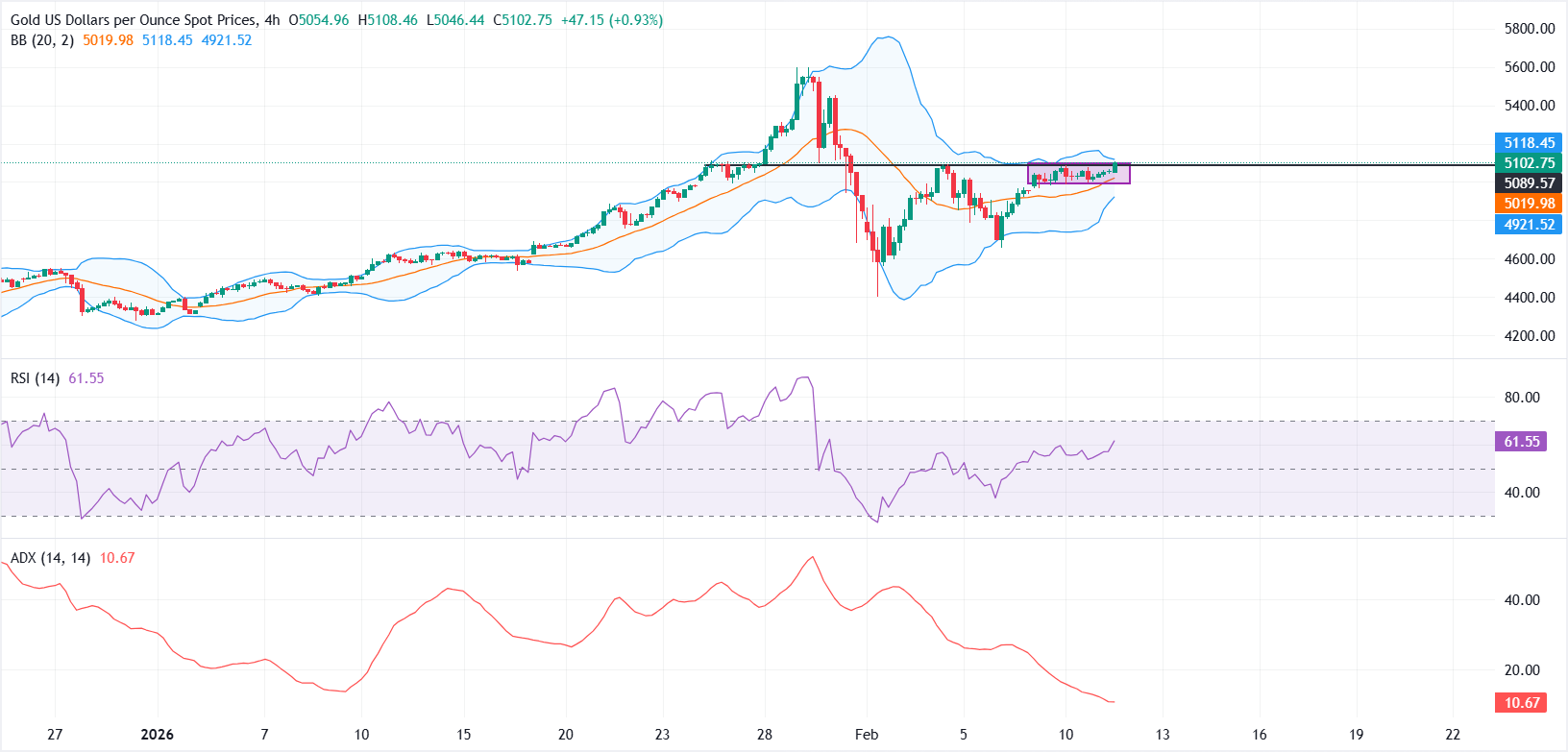
From a technical perspective, XAU/USD maintains a mild bullish bias, with buyers gradually gaining traction after successfully defending the $5,000 psychological level.
On the 4-hour chart, price hovers just below the upper Bollinger Band at $5,117.43, and a sustained break above this level would likely extend the current advance.
The Relative Strength Index (RSI), at 61, is rising and remains in bullish territory, pointing to improving momentum. On the downside, initial support is seen at the 20-period Simple Moving Average (SMA), which also marks the mid-Bollinger Band, around $5,019.75.
The Bollinger Bands are narrowing, signalling a contraction in volatility and a coiling phase. Trend strength remains weak, with the ADX at 10.56, suggesting that a sustained directional move would likely require a fresh catalyst, with the US Nonfarm Payrolls report in focus.
Failure to clear the upper band could trigger a pullback toward the $5,019.75-$4,922.06 support zone. Conversely, a decisive upside break would likely encourage band expansion and keep the near-term path pointed higher.
(The technical analysis of this story was written with the help of an AI tool.)
(This story was corrected on February 11 at 15:00 GMT to remove a reference to the US Nonfarm Payrolls report being still pending.)
Gold FAQs
Gold has played a key role in human’s history as it has been widely used as a store of value and medium of exchange. Currently, apart from its shine and usage for jewelry, the precious metal is widely seen as a safe-haven asset, meaning that it is considered a good investment during turbulent times. Gold is also widely seen as a hedge against inflation and against depreciating currencies as it doesn’t rely on any specific issuer or government.
Central banks are the biggest Gold holders. In their aim to support their currencies in turbulent times, central banks tend to diversify their reserves and buy Gold to improve the perceived strength of the economy and the currency. High Gold reserves can be a source of trust for a country’s solvency. Central banks added 1,136 tonnes of Gold worth around $70 billion to their reserves in 2022, according to data from the World Gold Council. This is the highest yearly purchase since records began. Central banks from emerging economies such as China, India and Turkey are quickly increasing their Gold reserves.
Gold has an inverse correlation with the US Dollar and US Treasuries, which are both major reserve and safe-haven assets. When the Dollar depreciates, Gold tends to rise, enabling investors and central banks to diversify their assets in turbulent times. Gold is also inversely correlated with risk assets. A rally in the stock market tends to weaken Gold price, while sell-offs in riskier markets tend to favor the precious metal.
The price can move due to a wide range of factors. Geopolitical instability or fears of a deep recession can quickly make Gold price escalate due to its safe-haven status. As a yield-less asset, Gold tends to rise with lower interest rates, while higher cost of money usually weighs down on the yellow metal. Still, most moves depend on how the US Dollar (USD) behaves as the asset is priced in dollars (XAU/USD). A strong Dollar tends to keep the price of Gold controlled, whereas a weaker Dollar is likely to push Gold prices up.