
Gold recovers from bearish gap but higher-for-longer rate fears cap gains
- Gold recovers after opening the week with a bearish gap amid ongoing Middle East uncertainty.
- Oil-driven inflation fears continue to support the higher-for-longer interest rate narrative, weighing on the non-yielding metal.
- Technically, XAU/USD maintains a near-term bullish bias while holding above the Bollinger mid-band support.
Gold (XAU/USD) recovers after opening the week with a bearish gap, supported by a softer US Dollar (USD). However, upside remains capped as persistent uncertainty surrounding the US-Iran war continues to fuel Oil-driven inflation fears, maintaining pressure on central banks to keep borrowing costs elevated.
At the time of writing, XAU/USD is trading around $4,735, up about 0.50% on the day after touching an intraday low near $4,648.
Nuclear disagreements keep US-Iran talks deadlocked
Hopes for a near-term peace deal faded after US President Donald Trump rejected Iran’s response to a US-backed proposal aimed at ending the war, calling it “totally unacceptable” in a post on Truth Social.
Iranian state media said Tehran’s proposal included demands for US compensation for war damages and stressed Iran’s sovereignty over the Strait of Hormuz.
Iran’s Foreign Ministry spokesperson Esmaeil Baghaei said on Monday that Tehran was only trying to secure its rights and had offered “generous and responsible” suggestions to the US. Baghaei also said the proposal by his country was not excessive and accused Washington of making “unreasonable demands.”
Despite ongoing diplomatic efforts, talks remain unresolved over Iran’s nuclear program, raising uncertainty over how long the US-Iran war could continue. This has heightened fears of prolonged supply disruptions through the Strait of Hormuz, keeping a geopolitical risk premium embedded in Oil prices.
Gold struggles as higher-for-longer rate expectations weigh on sentiment
Soaring Oil prices are reinforcing expectations that major central banks, particularly the Federal Reserve (Fed), may have to keep interest rates higher for longer and could even consider raising rates again if inflation pressure intensifies.
Investors are now awaiting the upcoming US Consumer Price Index (CPI) data due on Tuesday, which could influence expectations for the Fed’s monetary policy path.
According to the CME FedWatch Tool, traders largely expect the Fed to keep borrowing costs unchanged for the rest of the year, though markets are pricing in a small chance of a rate hike at the December meeting, with the probability standing around 20%.
A higher interest rate environment reduces the appeal of non-yielding assets like Gold because the precious metal does not offer any yield or interest. When borrowing costs remain elevated, investors often shift toward interest-bearing assets such as government bonds and other fixed-income instruments.
Against this backdrop, Gold’s upside remains capped. Still, downside pressure remains limited as ongoing geopolitical uncertainty supports safe-haven demand, while steady central bank, retail and investment buying continues to provide underlying support for the precious metal.
Technical analysis: Bollinger mid-band caps recovery attempts near $4,700
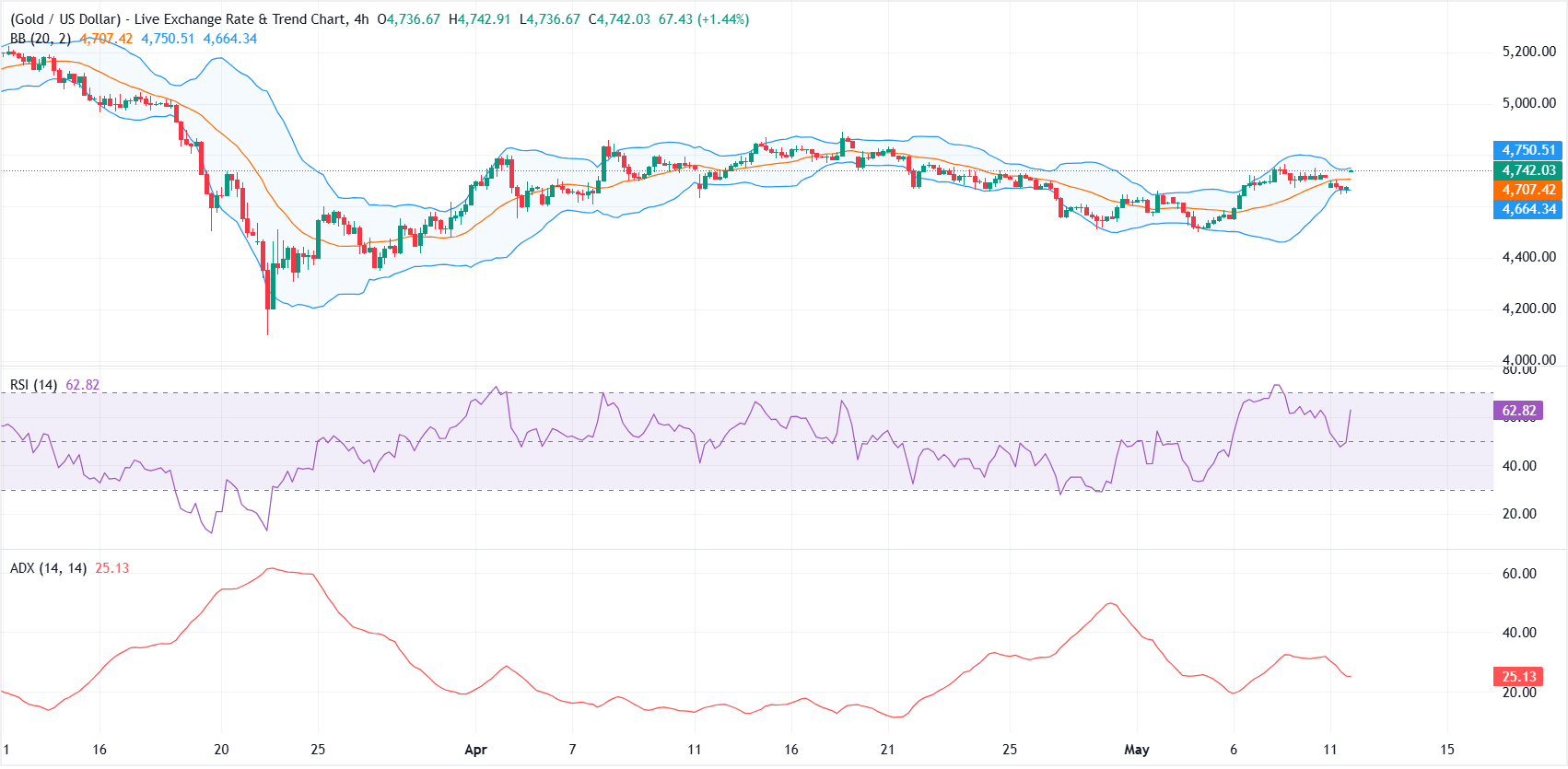
Technical Analysis:
On the 4-hour chart, XAU/USD metal holds above the 20-period Bollinger Simple Moving Average (SMA) at roughly $4,707, keeping a near-term bullish bias intact as price pushes toward the upper band resistance near $4,751. A firm Relative Strength Index (RSI) around 63 suggests positive momentum but shy of overbought territory, while an Average Directional Index (ADX) near 25 hints at a trend that is present but not yet strongly directional.
On the topside, immediate resistance is located at the upper Bollinger Band around $4,751, where upside attempts could face profit-taking. On the downside, initial support emerges at the mid-Bollinger SMA near $4,707, with the lower band around $4,664 providing a deeper cushion if a corrective pullback unfolds.
(The technical analysis of this story was written with the help of an AI tool.)
Gold FAQs
Gold has played a key role in human’s history as it has been widely used as a store of value and medium of exchange. Currently, apart from its shine and usage for jewelry, the precious metal is widely seen as a safe-haven asset, meaning that it is considered a good investment during turbulent times. Gold is also widely seen as a hedge against inflation and against depreciating currencies as it doesn’t rely on any specific issuer or government.
Central banks are the biggest Gold holders. In their aim to support their currencies in turbulent times, central banks tend to diversify their reserves and buy Gold to improve the perceived strength of the economy and the currency. High Gold reserves can be a source of trust for a country’s solvency. Central banks added 1,136 tonnes of Gold worth around $70 billion to their reserves in 2022, according to data from the World Gold Council. This is the highest yearly purchase since records began. Central banks from emerging economies such as China, India and Turkey are quickly increasing their Gold reserves.
Gold has an inverse correlation with the US Dollar and US Treasuries, which are both major reserve and safe-haven assets. When the Dollar depreciates, Gold tends to rise, enabling investors and central banks to diversify their assets in turbulent times. Gold is also inversely correlated with risk assets. A rally in the stock market tends to weaken Gold price, while sell-offs in riskier markets tend to favor the precious metal.
The price can move due to a wide range of factors. Geopolitical instability or fears of a deep recession can quickly make Gold price escalate due to its safe-haven status. As a yield-less asset, Gold tends to rise with lower interest rates, while higher cost of money usually weighs down on the yellow metal. Still, most moves depend on how the US Dollar (USD) behaves as the asset is priced in dollars (XAU/USD). A strong Dollar tends to keep the price of Gold controlled, whereas a weaker Dollar is likely to push Gold prices up.