
Gold Price Forecast: XAU/USD rises to near $4,230, remains broadly confined above 20-day EMA
- Gold price rises to near $4,230, but is well inside the four-day trading range.
- The Fed is expected to cut interest rates next week and might call for a pause.
- Poor labor demand has contributed significantly to firm Fed dovish bets.
Gold price (XAU/USD) gains 0.4% to near $4,230 during the European trading session on Friday. The yellow metal trades firmly, but is confided in a tight range between $4,164 and $4,265 for the last four trading days.
The outlook of the precious metal remains bullish as the Federal Reserve (Fed) is widely anticipated to cut interest rates in its monetary policy announcement on Wednesday. Lower interest rates by the Fed bode well for non-yielding assets, such as Gold.
According to the CME FedWatch tool, the probability of the Fed cutting interest rates by 25 basis points (bps) to 3.50%-3.75% in the December policy meeting is 87%. Fed dovish expectations are prompted by weakening United States (US) labor market conditions.
With expectations pointing to a 25-bps interest rate reduction, investors will pay more attention to the monetary policy guidance of 2026. Fed officials are expected to adopt a restrictive monetary policy outlook as inflation remains well above the 2% target for months.
During the European session, the US Dollar (USD) strives to hold its immediate lows, with the US Dollar Index (DXY) trading cautiously near the five-week low around 98.75.
Gold technical analysis
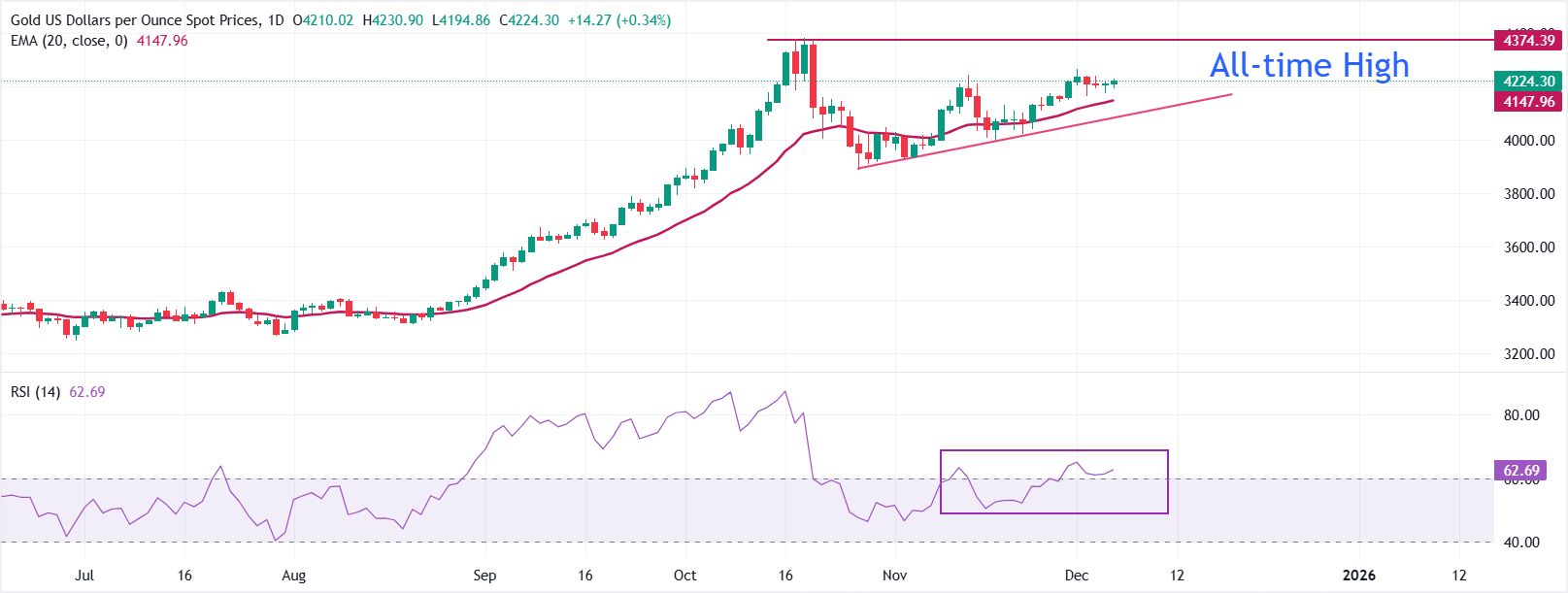
In the daily chart, XAU/USD trades around $4,190 during Friday’s European trading hours. The 20-day Exponential Moving Average (EMA) at $4,147.96 rises, with price holding above it to maintain a positive bias. Pullbacks toward the 20-day EMA would find support while its slope stays higher.
The 14-day Relative Strength Index (RSI) rebounds after bending to near 60.00, suggesting that the momentum will remain in play until it holds that level.
The 20-day EMA remains positively aligned, keeping dip-buying interest in play. The rising trend line from the October 28 low of $3,933.90 underpins the bias, offering support near $4,110. A daily close below that line would flag a deeper pullback towards the psychological level of $4,000, while holding above it would leave scope for an extension of the advance.
(The technical analysis of this story was written with the help of an AI tool)
Gold FAQs
Gold has played a key role in human’s history as it has been widely used as a store of value and medium of exchange. Currently, apart from its shine and usage for jewelry, the precious metal is widely seen as a safe-haven asset, meaning that it is considered a good investment during turbulent times. Gold is also widely seen as a hedge against inflation and against depreciating currencies as it doesn’t rely on any specific issuer or government.
Central banks are the biggest Gold holders. In their aim to support their currencies in turbulent times, central banks tend to diversify their reserves and buy Gold to improve the perceived strength of the economy and the currency. High Gold reserves can be a source of trust for a country’s solvency. Central banks added 1,136 tonnes of Gold worth around $70 billion to their reserves in 2022, according to data from the World Gold Council. This is the highest yearly purchase since records began. Central banks from emerging economies such as China, India and Turkey are quickly increasing their Gold reserves.
Gold has an inverse correlation with the US Dollar and US Treasuries, which are both major reserve and safe-haven assets. When the Dollar depreciates, Gold tends to rise, enabling investors and central banks to diversify their assets in turbulent times. Gold is also inversely correlated with risk assets. A rally in the stock market tends to weaken Gold price, while sell-offs in riskier markets tend to favor the precious metal.
The price can move due to a wide range of factors. Geopolitical instability or fears of a deep recession can quickly make Gold price escalate due to its safe-haven status. As a yield-less asset, Gold tends to rise with lower interest rates, while higher cost of money usually weighs down on the yellow metal. Still, most moves depend on how the US Dollar (USD) behaves as the asset is priced in dollars (XAU/USD). A strong Dollar tends to keep the price of Gold controlled, whereas a weaker Dollar is likely to push Gold prices up.