
Gold Price Forecast: XAU/USD hits lows near $4,650 as Fed easing hopes dim
- Gold extends its reversal to levels close to $4,650 from last week's highs above $4,760.
- Fading hopes of a swift resolution of the Iran conflict are weighing on precious metals.
- US employment data beat expectations in April, backing claims for a hawkish Fed pivot
Gold (XAU/USD) pulls back from last week’s high on Monday, reaching session lows a few dollars above the $4,650 level at the time of writing. Waning hopes of a swift end to the US-Iran war and strong US employment data, which eases pressures on the Federal Reserve to cut rates anytime soon, are hurting precious metals on Monday.
US President Donald Trump dismissed Iran’s late proposal of a peace agreement, which, according to Iran’s state media, includes recognition of the sovereignty of the Strait of Hormuz. To make matters worse, Israeli Prime Minister Benjamin Netanyahu affirmed that the war will not be over until Iran’s enriched uranium is removed, an option Tehran considers utterly unacceptable.
Furthermore, US data released on Friday revealed that jobs grew well beyond expectations in April, suggesting that the labour market is finally stabilising. These figures endorse Federal Reserve (Fed) hawks and curb hopes of any monetary easing move during the foreseeable future. US Treasury yields have jumped on Monday, adding pressure on precious metals.
Technical Analysis: Gold is in a bearish correction
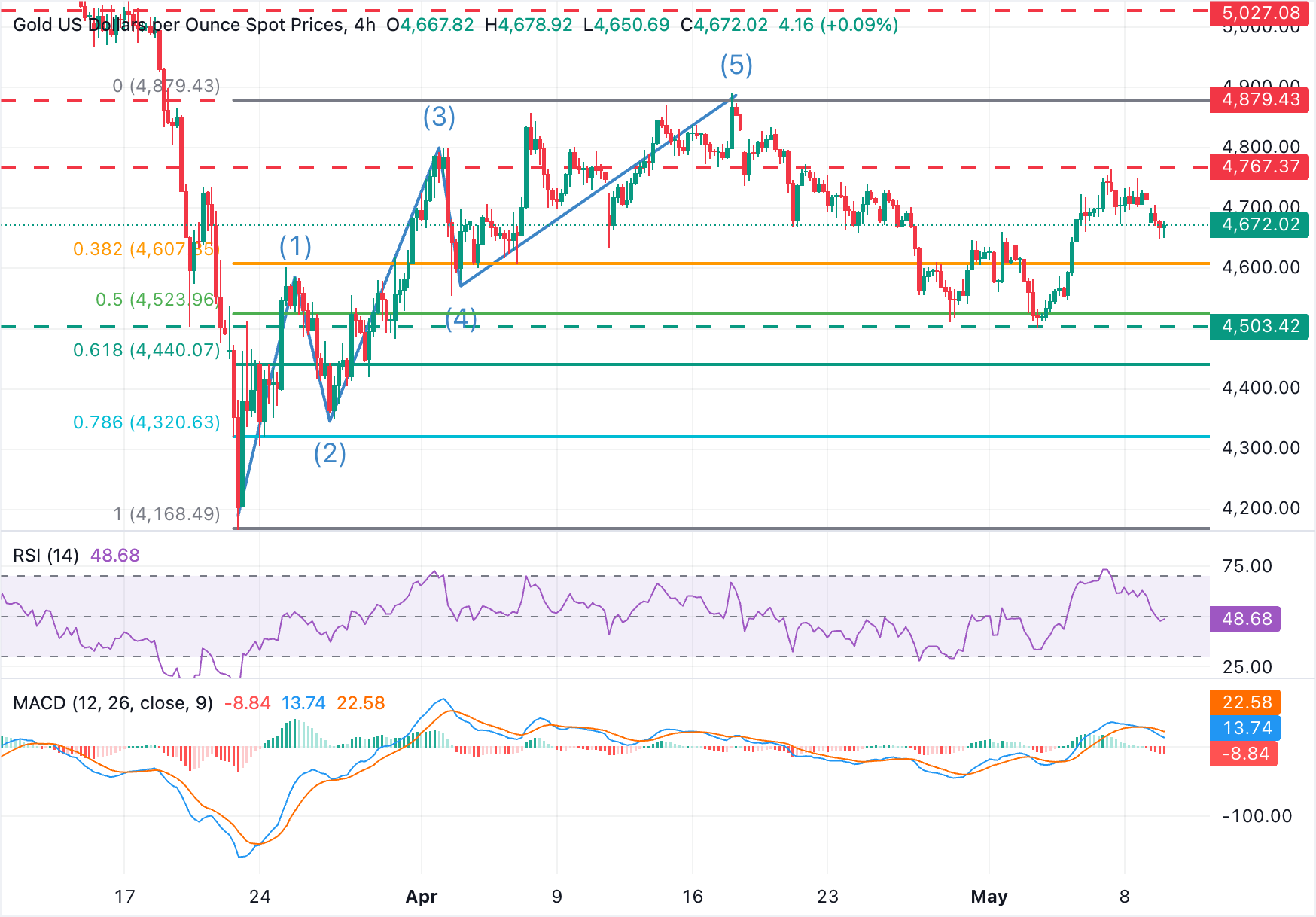
XAU/USD confirms a bearish near-term bias after last week's lower high, with momentum indicators reinforcing the soft tone. The Relative Strength Index is below 50, and the Moving Average Convergence Divergence (MACD) line is trending lower after crossing the Signal line, all in all highlighting growing selling pressure.
From an Elliott Wave analysis perspective, the pair has completed a 5-wave bullish cycle and is on an A-B-C corrective phase. Late April and early May highs at the $4,655 area and the 38.2% Fibonacci retracement of the mentioned cycle, near $4,600, are likely to test bears ahead of last week's lows near $4,500. A plausible target for a correction is the 78.6% Fibonacci retracement, at $4,320
On the topside, immediate resistance emerges at Thursday's high of at $4,764 ahead of mid-April highs in the area of $4,880.
(The technical analysis of this story was written with the help of an AI tool.)
(This story was corrected on May 11 at 11:35 GMT to say that Benjamin Netanyahu is Israel's Prime Minister, and not President, as previously stated.)
Gold FAQs
Gold has played a key role in human’s history as it has been widely used as a store of value and medium of exchange. Currently, apart from its shine and usage for jewelry, the precious metal is widely seen as a safe-haven asset, meaning that it is considered a good investment during turbulent times. Gold is also widely seen as a hedge against inflation and against depreciating currencies as it doesn’t rely on any specific issuer or government.
Central banks are the biggest Gold holders. In their aim to support their currencies in turbulent times, central banks tend to diversify their reserves and buy Gold to improve the perceived strength of the economy and the currency. High Gold reserves can be a source of trust for a country’s solvency. Central banks added 1,136 tonnes of Gold worth around $70 billion to their reserves in 2022, according to data from the World Gold Council. This is the highest yearly purchase since records began. Central banks from emerging economies such as China, India and Turkey are quickly increasing their Gold reserves.
Gold has an inverse correlation with the US Dollar and US Treasuries, which are both major reserve and safe-haven assets. When the Dollar depreciates, Gold tends to rise, enabling investors and central banks to diversify their assets in turbulent times. Gold is also inversely correlated with risk assets. A rally in the stock market tends to weaken Gold price, while sell-offs in riskier markets tend to favor the precious metal.
The price can move due to a wide range of factors. Geopolitical instability or fears of a deep recession can quickly make Gold price escalate due to its safe-haven status. As a yield-less asset, Gold tends to rise with lower interest rates, while higher cost of money usually weighs down on the yellow metal. Still, most moves depend on how the US Dollar (USD) behaves as the asset is priced in dollars (XAU/USD). A strong Dollar tends to keep the price of Gold controlled, whereas a weaker Dollar is likely to push Gold prices up.