
Gold consolidates below $5,200 as traders weigh geopolitics, Fed rate outlook
- Gold consolidates below $5,200 as traders weigh Middle East tensions against fading Fed interest rate-cut bets.
- Technically, XAU/USD holds above key $5,140 support with resistance seen at $5,200-$5,250.
- Traders await US PPI data for fresh short-term direction.
Gold (XAU/USD) consolidates with mild losses on Friday, as momentum stalls within this week’s established range. The metal is showing little directional conviction, with traders balancing lingering geopolitical tensions against shifting expectations for the Federal Reserve’s (Fed) monetary policy path.
At the time of writing, XAU/USD is trading around $5,177, as bears continue to defend the $5,200 handle. Despite Friday's slight retreat, Gold looks set to post a fourth consecutive week of gains.
No news from Geneva
The third round of indirect US-Iran nuclear talks ended in Geneva on Thursday without any meaningful progress, with Washington increasing its military deployment in the region. The possibility of military action remains well alive, supporting safe-haven demand and limiting Gold’s downside.
Iranian Foreign Minister Abbas Araghchi described the latest round of talks as “good.” “These were the most serious and longest talks,” he said, adding that further technical discussions will be held next week in Vienna.
Markets increasingly doubt a Fed rate cut in June
On the monetary policy front, markets are nearly certain that the Fed will keep interest rates unchanged at its March and April meetings, while trimming bets also on a June rate cut as policymakers continue to stress that inflation must show clearer signs of cooling before lowering rates.
This repricing of rate-cut expectations, with a hold now expected also in June, weighs on Gold and lends support to the US Dollar (USD), capping gains in XAU/USD.
Market sentiment has also been dampened by renewed uncertainty surrounding US trade policy. Trade tensions intensified earlier this week after a fresh 10% global tariff took effect, just days after the US Supreme Court ruled against the Trump administration’s earlier use of emergency powers to impose tariffs.
Against this backdrop of fading rate-cut expectations and ongoing Middle East tensions, Gold may continue to trade within a narrow range in the near term. The US Producer Price Index (PPI) data at 13:30 GMT could drive short-term moves in XAU/USD before the trading week ends.
The broader outlook for Gold remains tilted to the upside, with the metal on track for a seventh straight monthly gain, supported by steady central bank buying, solid ETF inflows, and persistent geopolitical and economic uncertainty.
Technical analysis: XAU/USD trades sideways as momentum cools
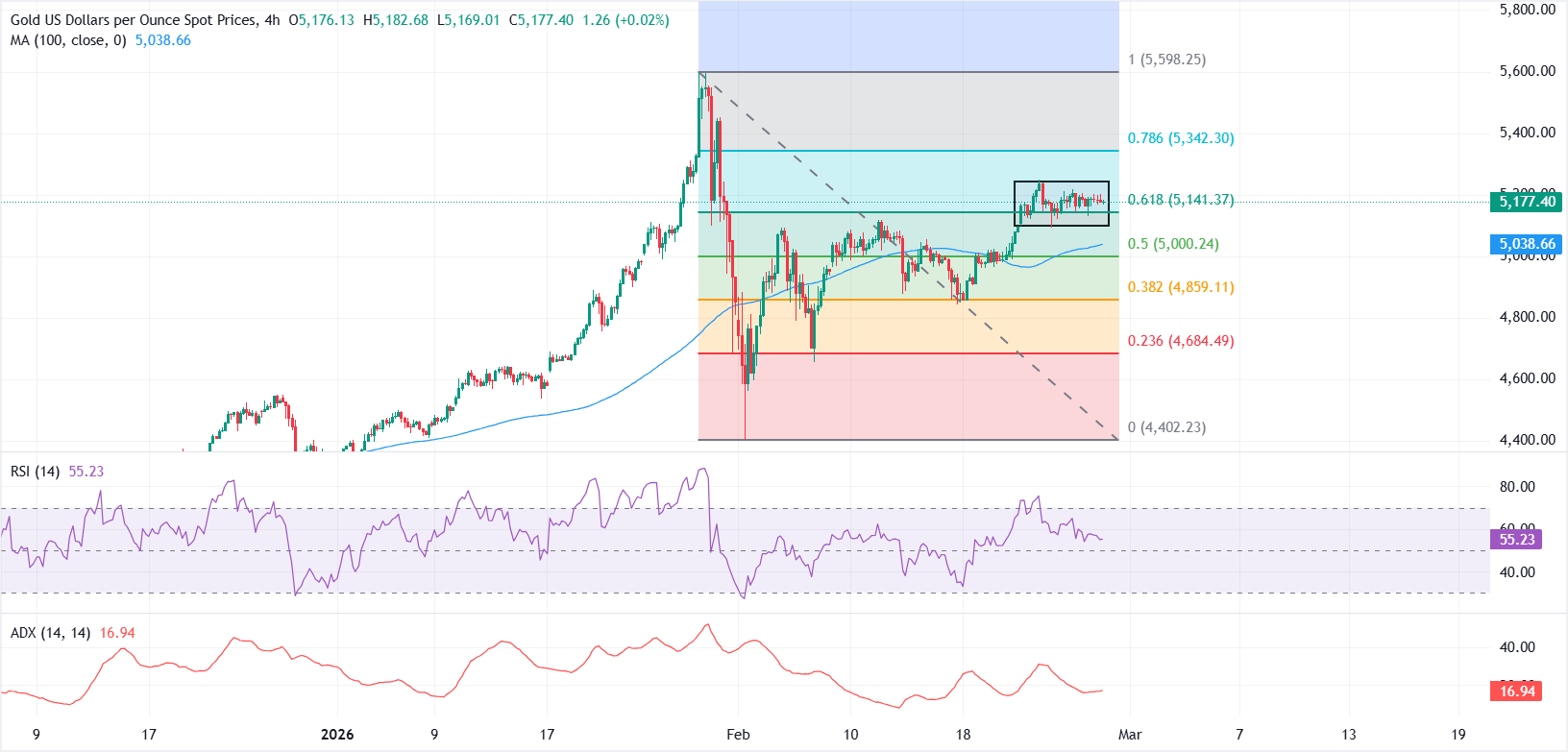
The near-term bias remains mildly bullish to neutral on the 4-hour chart, as price continues to hold comfortably above the 100-period Simple Moving Average (SMA) near $5,039.
Immediate support is seen around $5,140, aligning closely with the 61.8% Fibonacci retracement at $5,141, measured from the $4,402 low to the the $5,598 all-time high. The 100-period SMA at $5,038 reinforces a stronger support zone beneath. A sustained break below $5,038 could expose the 50% retracement at $5,000 and weaken the current bullish structure.
On the upside, initial resistance is located in the $5,200-$5,250 region, followed by the 78.6% Fibonacci retracement at $5,342. Rejection near $5,342 would suggest fading upside momentum, while a decisive break above this level could open the door toward the $5,598 peak.
The Relative Strength Index (RSI) has eased to 55, retreating from overbought territory above 70, indicating cooling but still positive momentum rather than outright exhaustion.
The Average Directional Index (ADX) around 17 signals a weak trend environment, so upside progress would depend on fresh buying interest rather than strong trend continuation.
Gold FAQs
Gold has played a key role in human’s history as it has been widely used as a store of value and medium of exchange. Currently, apart from its shine and usage for jewelry, the precious metal is widely seen as a safe-haven asset, meaning that it is considered a good investment during turbulent times. Gold is also widely seen as a hedge against inflation and against depreciating currencies as it doesn’t rely on any specific issuer or government.
Central banks are the biggest Gold holders. In their aim to support their currencies in turbulent times, central banks tend to diversify their reserves and buy Gold to improve the perceived strength of the economy and the currency. High Gold reserves can be a source of trust for a country’s solvency. Central banks added 1,136 tonnes of Gold worth around $70 billion to their reserves in 2022, according to data from the World Gold Council. This is the highest yearly purchase since records began. Central banks from emerging economies such as China, India and Turkey are quickly increasing their Gold reserves.
Gold has an inverse correlation with the US Dollar and US Treasuries, which are both major reserve and safe-haven assets. When the Dollar depreciates, Gold tends to rise, enabling investors and central banks to diversify their assets in turbulent times. Gold is also inversely correlated with risk assets. A rally in the stock market tends to weaken Gold price, while sell-offs in riskier markets tend to favor the precious metal.
The price can move due to a wide range of factors. Geopolitical instability or fears of a deep recession can quickly make Gold price escalate due to its safe-haven status. As a yield-less asset, Gold tends to rise with lower interest rates, while higher cost of money usually weighs down on the yellow metal. Still, most moves depend on how the US Dollar (USD) behaves as the asset is priced in dollars (XAU/USD). A strong Dollar tends to keep the price of Gold controlled, whereas a weaker Dollar is likely to push Gold prices up.