
Gold clears $4,200 as optimism on Middle East deal dents inflation woes
- A potential Hormuz reopening could ease energy-driven inflation pressures.
- Improved consumer sentiment tempers safe-haven demand for Gold.
- Warsh’s first Fed decision and SEP headline next week.
Gold (XAU/USD) price consolidates above the $4,200 figure on Friday as market participants are optimistic about a potential US-Iran deal, set to be signed next week, according to newswires. Meanwhile, households in the US are becoming more optimistic about the economy. The XAU/USD pair trades at $4,216, up 0.11%.
XAU/USD steadies as deal chatter offsets firmer yields
Investors' mood turned optimistic amid news that the Middle East conflict could end if Washington and Tehran proceed with the signing of the Islamabad Memorandum of Understanding (MOU). There is growing speculation about a signing at the G7 meeting in Geneva, Switzerland, but the Iranian Foreign Ministry spokesperson said that Iran’s decision-making bodies are meeting on the MOU and that he cannot confirm the details of the memorandum.
If both parties agree, the Strait of Hormuz will reopen, which could drive energy prices lower and ease inflationary pressures on major central banks that have expressed concerns about the energy shock sparked by the conflict.
Central banks like the Reserve Bank of Australia (RBA) and the European Central Bank (ECB) raised rates by 75 and 25 basis points, respectively, during the year. However, a quick resolution of the conflict might prevent others, such as the Reserve Bank of New Zealand (RBNZ), the Bank of England (BoE), and the Federal Reserve (Fed), from tightening policy.
Despite this, US Treasury yields are edging higher, with the 10-year T-note up 1.5 basis points to 4.477%, a headwind for the yellow metal. At the same time, the US Dollar Index (DXY), which measures the American currency’s performance against six currencies, holds steady at 99.77, up 0.06%.
Data during the day showed that US households are becoming more optimistic as the US Consumer Sentiment in June improved from 44.8 to 48.9 in the preliminary reading, while inflation expectations for one year eased from 4.8% to 4.6%.
Earlier this week, US inflation data increased speculation that the Fed might raise rates at least once this year. But since news of a potential deal between the US and Iran decreased from around 88% to 67%.
Next week, the US economic docket will feature the Fed’s monetary policy decision, the first one led by the new Chairman Kevin Warsh, the release of the Summary of Economic Projections (SEP) and Retail Sales.
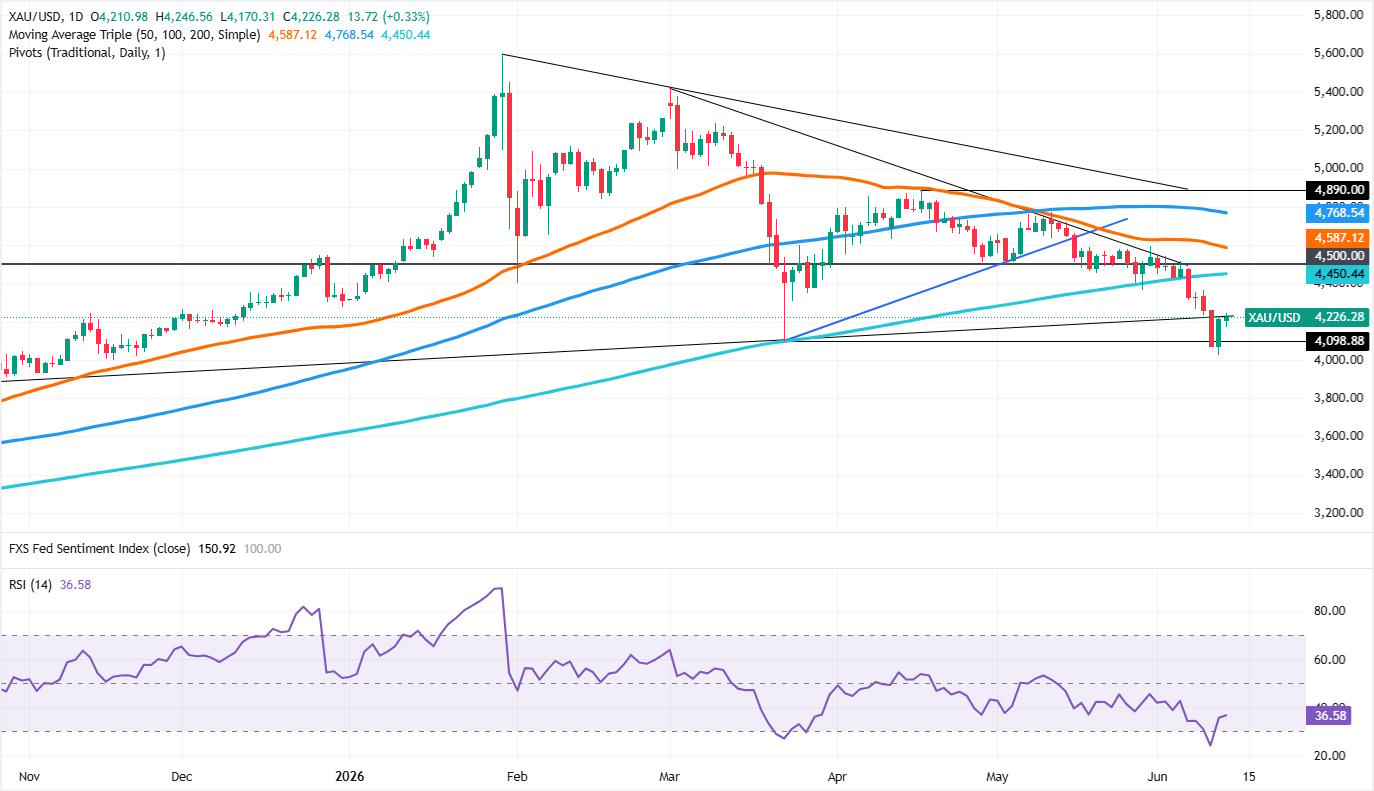
XAU/USD technical outlook: Gold rises past $4,200 on US-Iran war deal
Gold price is neutral to downward-biased, even though it recovered 3.50% on Thursday, clearing the way for a move above $4,200. Momentum remains downward-biased, as shown by the Relative Strength Index (RSI), but its recent break above the 30 level opened the door for buyers to drive prices higher in the near term.
The first key resistance level is$4,250. A breach of the latter will expose the $4,300 mark, followed by the 200-day Simple Moving Average (SMA) at $4,450, ahead of $4,500.
On the downside, the first support for XAU/USD is at $4,200. Below this level sit key psychological levels at $4,150, ahead of the June 11 daily low of $4,023, and $4,000.
Gold FAQs
Gold has played a key role in human’s history as it has been widely used as a store of value and medium of exchange. Currently, apart from its shine and usage for jewelry, the precious metal is widely seen as a safe-haven asset, meaning that it is considered a good investment during turbulent times. Gold is also widely seen as a hedge against inflation and against depreciating currencies as it doesn’t rely on any specific issuer or government.
Central banks are the biggest Gold holders. In their aim to support their currencies in turbulent times, central banks tend to diversify their reserves and buy Gold to improve the perceived strength of the economy and the currency. High Gold reserves can be a source of trust for a country’s solvency. Central banks added 1,136 tonnes of Gold worth around $70 billion to their reserves in 2022, according to data from the World Gold Council. This is the highest yearly purchase since records began. Central banks from emerging economies such as China, India and Turkey are quickly increasing their Gold reserves.
Gold has an inverse correlation with the US Dollar and US Treasuries, which are both major reserve and safe-haven assets. When the Dollar depreciates, Gold tends to rise, enabling investors and central banks to diversify their assets in turbulent times. Gold is also inversely correlated with risk assets. A rally in the stock market tends to weaken Gold price, while sell-offs in riskier markets tend to favor the precious metal.
The price can move due to a wide range of factors. Geopolitical instability or fears of a deep recession can quickly make Gold price escalate due to its safe-haven status. As a yield-less asset, Gold tends to rise with lower interest rates, while higher cost of money usually weighs down on the yellow metal. Still, most moves depend on how the US Dollar (USD) behaves as the asset is priced in dollars (XAU/USD). A strong Dollar tends to keep the price of Gold controlled, whereas a weaker Dollar is likely to push Gold prices up.