
Federal Reserve set to stand pat as market hopes for interest-rate cuts fade
- The US Federal Reserve is expected to leave the policy rate unchanged for the second consecutive meeting.
- The Summary of Economic Projections will offer key insights into policy outlook as markets fear an inflation comeback due to the spike in energy prices.
- Fed Chair Powell’s comments could ramp up USD volatility as the Iran war has sharply reduced expectations for rate cuts this year.
The United States (US) Federal Reserve (Fed) announces its interest rate decision on Wednesday, a pivotal meeting for markets to gauge the stance of the world’s most important central bank after an energy shock that could put the Fed’s dual mandate in tension. While the main decision on interest rates is a given, the surge in Oil prices after the Iran war adds a layer of uncertainty that could turn this meeting into much more interesting – and more volatile for markets – than initially expected.
Markets widely expect the Federal Open Market Committee (FOMC) to keep the policy rate unchanged in the range of 3.5%-3.75% for the second consecutive meeting.
As this decision is nearly fully priced in, the Summary of Economic Projections (SEP) and Fed Chair Jerome Powell’s comments in the post-meeting press conference could impact the US Dollar’s (USD) performance.
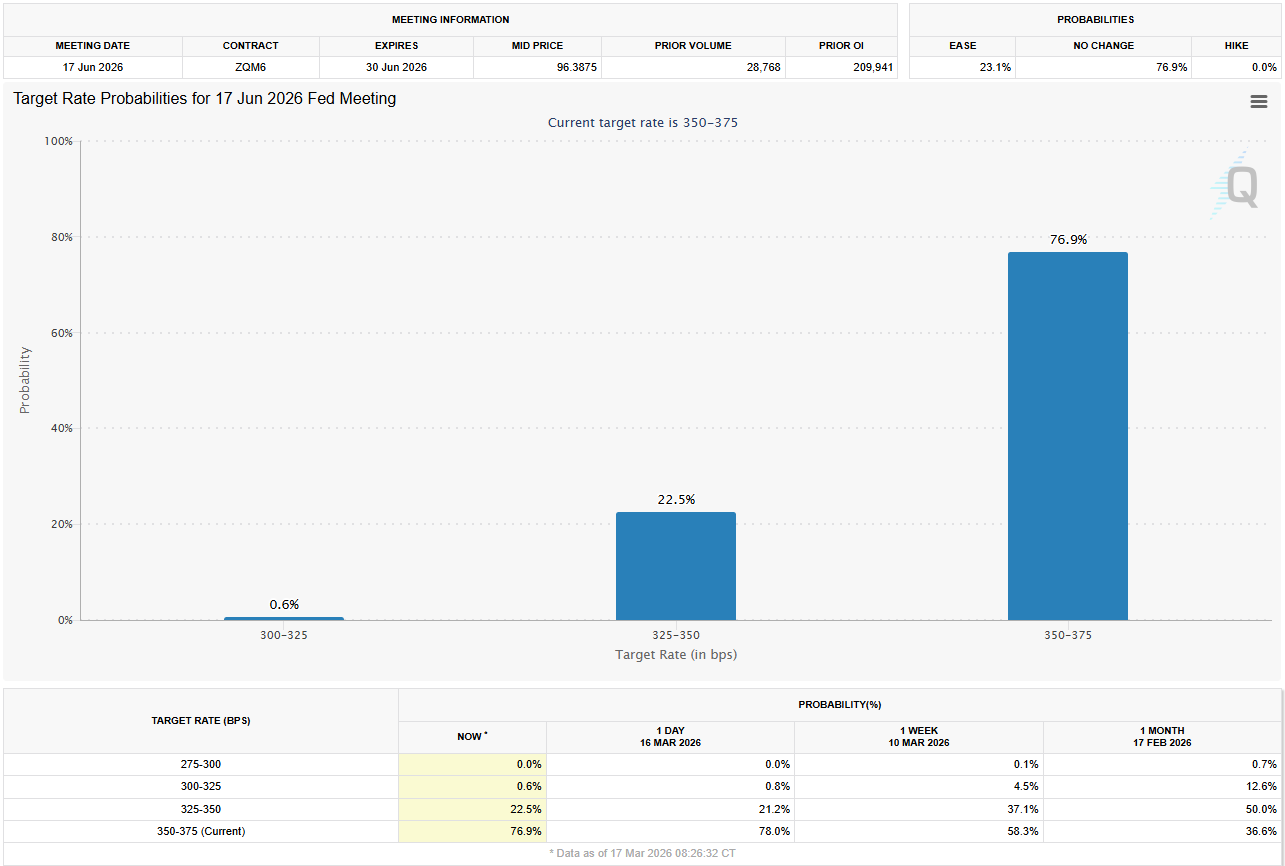
The CME FedWatch Tool shows that investors see virtually no chance of a rate cut in either March or April, while pricing in more than 75% probability of another policy hold in June. Actually, markets currently expect only one interest-rate cut this year, a big change compared to the three cuts anticipated before the breakout of the war in Iran.
What changed? The Fed will be conducting its meeting under extraordinary circumstances as rising crude Oil prices, due to the closure of the Strait of Hormuz amid the ongoing war between the United States (US) and Iran, heighten the uncertainty surrounding the inflation outlook.
DBS Group economist Philip Wee argues that the Fed enters its March 17-18 meeting caught between surging energy-driven inflation and weakening US growth.
“Fed Chair Jerome Powell may still be haunted by the "behind the curve" spectre of 2022, when a delayed response to surging prices forced a painful, aggressive hiking cycle," Wee notes. This time, however, the Fed is currently confronting a fragile economy, he adds, citing the downward revision to the fourth-quarter Gross Domestic Product (GDP) growth and the 92,000 contraction recorded in Nonfarm Payrolls (NFP) in February.
“The FOMC must determine whether these energy price spikes represent a primary inflationary threat requiring higher rates or a consumer tax necessitating cuts," Wee concludes.
When will the Fed announce its interest rate decision and how could it affect EUR/USD?
The Fed is scheduled to announce its interest rate decision and publish the monetary policy statement, alongside the SEP, at 18:00 GMT. This will be followed by Fed Chair Jerome Powell's press conference starting at 18:30 GMT.
The rate decision itself is unlikely to trigger a significant market reaction, but investors will scrutinize the SEP and Fed Chair Powell’s tone.
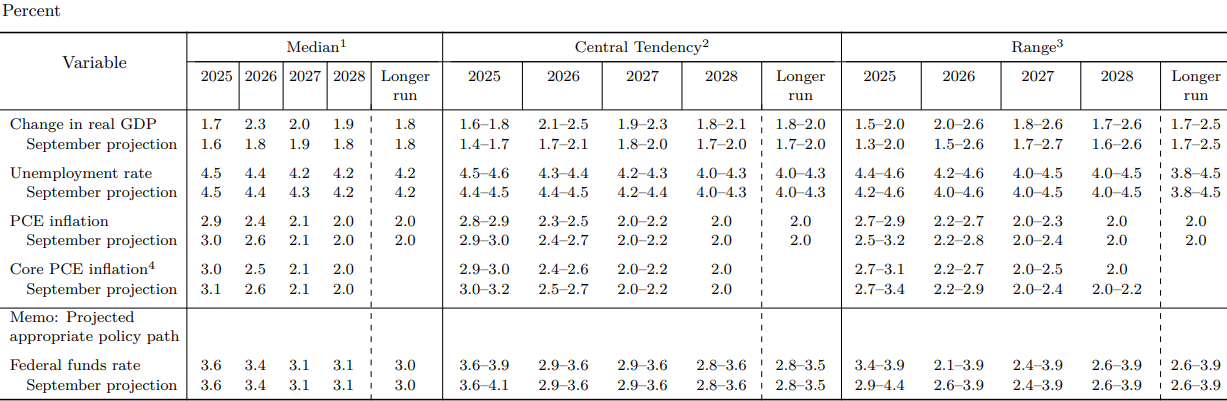
The latest SEP, published in December, showed that the central bank’s projections implied a 25-basis-point (bps) rate cut in 2026, and another 25 bps reduction in 2027.
Additionally, Fed policymakers’ end-2026 projection for PCE inflation came down to 2.4% from 2.6% in September’s SEP. Given the recent rise in Oil prices, Fed officials are likely to point to higher inflation ahead.
The CME FedWatch Tool points to about a 30% chance that the policy rate will remain unchanged at the range of 3.5%-3.75% at the end of the year. In case the dot plot highlights that a majority of policymakers prefer to hold the policy steady for the rest of 2026, in addition to an upward revision to the end-2026 PCE inflation projection, the USD could gather strength with the immediate reaction and weigh heavily on EUR/USD.
Conversely, the USD could come under bearish pressure and allow EUR/USD to gain traction if the SEP points to at least one 25 bps reduction in rates this year.
Once markets digest the policy statement and the SEP, they will shift their focus to Powell’s presser, which will likely focus on fears about reviving inflation and his future at the Fed.
If Powell hints that they will have to prioritize controlling inflation and inflation expectations because of rising Oil prices, this could reaffirm expectations for a steady policy rate for longer and support the USD. On the other hand, the USD is likely to lose interest in case Powell doesn’t hit the panic button, noting that they will need more time to assess how the US-Iran conflict could influence inflation dynamics and that they will need to be more attentive to labor market conditions and support growth after seeing the sharp decline in February’s NFP.
“Powell will carefully avoid giving any strong forward-looking signals and emphasize the two-sided nature of the risks stemming from the energy supply shock,” said Danske Bank Research Team.
“Most FOMC participants still see the current policy rate level somewhat above neutral, and once the energy uncertainty eases, we expect the Fed to eventually deliver two more rate cuts in June and September,” they add. “Extending uncertainty could push the expected cuts further out into the future but not erase them completely, which we expect to be reflected also in the updated dots,” the analysts conclude.
Eren Sengezer, European Session Lead Analyst at FXStreet, provides a short-term technical outlook for EUR/USD:
“The near-term technical outlook points to a buildup in bearish pressure. The 20-day Simple Moving Average completed a bearish cross with the 50-day SMA and recently dropped below the 100-day and 200-day SMAs. Additionally, the Relative Strength Index (RSI) indicator stays below 40 after recovering slightly from the oversold region below 30.”
“On the downside, 1.1380 (Fibonacci 38.2% retracement level of the 2025-2026 uptrend) aligns as a key support level ahead of 1.1170 (Fibonacci 50% retracement). In case EUR/USD reaches the 1.1660-1.1700 region, where the Fibonacci 23.6% retracement, the 100-day SMA and the 200-day SMA form a strong resistance, technical buyers could take action. In this scenario, 1.1900 (round level, static level) could be seen as the next technical hurdle.”
Inflation FAQs
Inflation measures the rise in the price of a representative basket of goods and services. Headline inflation is usually expressed as a percentage change on a month-on-month (MoM) and year-on-year (YoY) basis. Core inflation excludes more volatile elements such as food and fuel which can fluctuate because of geopolitical and seasonal factors. Core inflation is the figure economists focus on and is the level targeted by central banks, which are mandated to keep inflation at a manageable level, usually around 2%.
The Consumer Price Index (CPI) measures the change in prices of a basket of goods and services over a period of time. It is usually expressed as a percentage change on a month-on-month (MoM) and year-on-year (YoY) basis. Core CPI is the figure targeted by central banks as it excludes volatile food and fuel inputs. When Core CPI rises above 2% it usually results in higher interest rates and vice versa when it falls below 2%. Since higher interest rates are positive for a currency, higher inflation usually results in a stronger currency. The opposite is true when inflation falls.
Although it may seem counter-intuitive, high inflation in a country pushes up the value of its currency and vice versa for lower inflation. This is because the central bank will normally raise interest rates to combat the higher inflation, which attract more global capital inflows from investors looking for a lucrative place to park their money.
Formerly, Gold was the asset investors turned to in times of high inflation because it preserved its value, and whilst investors will often still buy Gold for its safe-haven properties in times of extreme market turmoil, this is not the case most of the time. This is because when inflation is high, central banks will put up interest rates to combat it. Higher interest rates are negative for Gold because they increase the opportunity-cost of holding Gold vis-a-vis an interest-bearing asset or placing the money in a cash deposit account. On the flipside, lower inflation tends to be positive for Gold as it brings interest rates down, making the bright metal a more viable investment alternative.