
EUR/USD holds losses below 1.1700 with ECB and Fed coming into focus
- EUR/USD retraces Monday's gains and drops back below 1.1700.
- The US Dollar regains lost ground as investors shift their focus to monetary policy.
- Oil prices are ticking higher as Trump dislikes Iran's peace proposal.
The Euro (EUR) has reversed the previous two trading days' recovery against the US Dollar (USD) on Tuesday and languishes right below 1.1700 ahead of the US session opening. The safe-haven US Dollar is building up momentum, with markets increasingly cautious, awaiting central banks' decisions and US President Donald Trump's negative reaction to the last peace proposal by Tehran.
The Federal Reserve (Fed) will most likely leave interest rates unchanged in the 3.50%-3.75% range on Wednesday at what should be the last meeting of Jerome Powell as the bank’s Chairman. Senator Thom Tillis lifted his block on the nomination of former Governor Kevin Warsh as the next chairman, which lays the ground for Powell's replacement in May.
On Thursday, the focus will shift to the European Central Bank (ECB). ECB officials have already shown their willingness to hike interest rates this year, but they might prefer to wait for a more complete assessment of the economic impact of Iran’s war. Investors are expecting a hawkish hold this week, pointing to a rate hike in June or July.
The conflict in the Middle East, meanwhile, remains stalled. A report by Reuters citing a US official affirms that Trump did not like Iran’s peace plan, as it does not address the nuclear issue. This keeps a high degree of uncertainty with the Strait of Hormuz closed, and Brent Oil price well above $100, adding pressure on crude-importing Eurozone economies and weighing on the Euro.
Technical Analysis: Bears will meet strong support below 1.1675
,
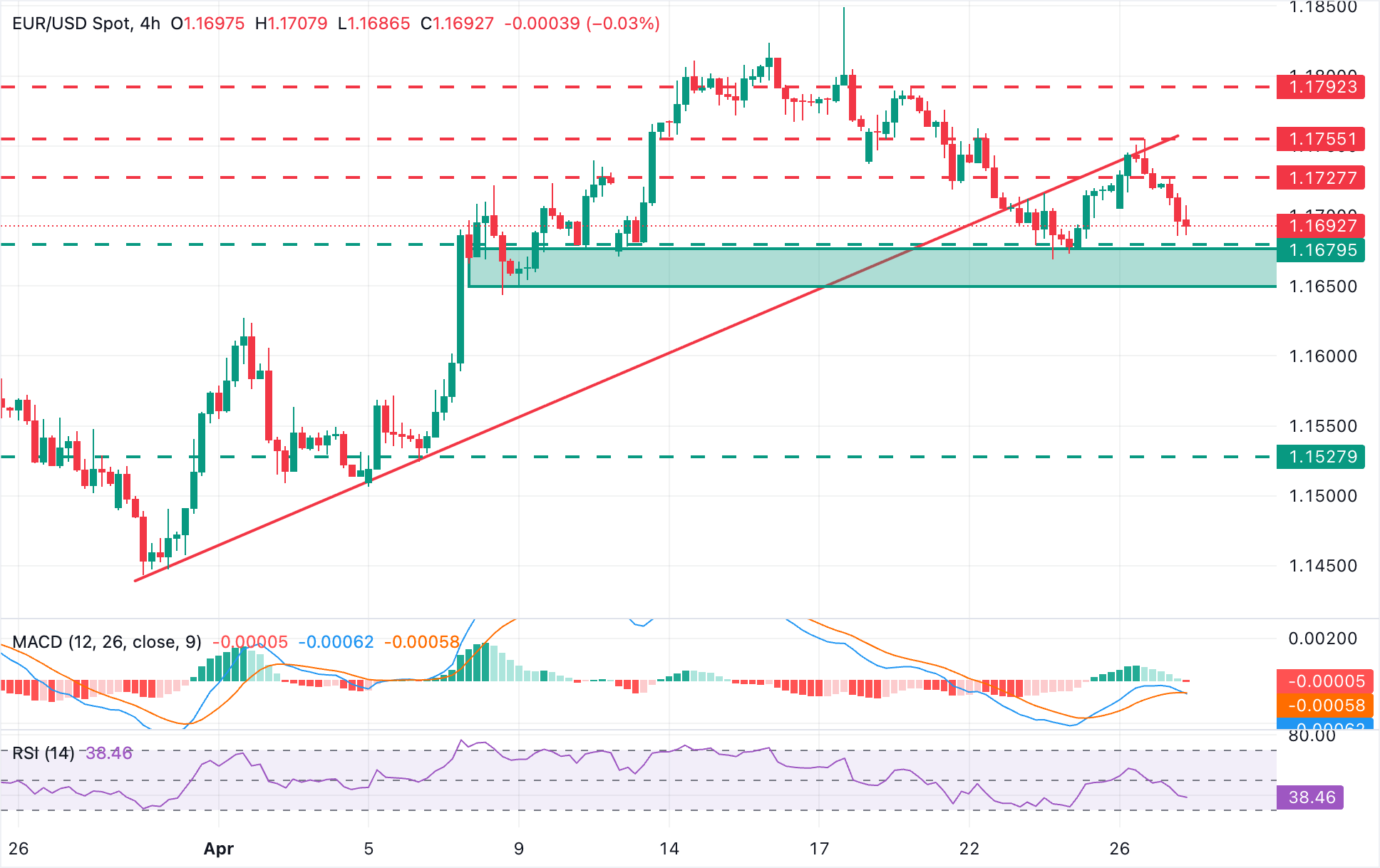
EUR/USD recovery attempts were rejected on Monday at a former trendline support, now turned into resistance, and the break of the 1.1700 level on Tuesday has confirmed the bearish bias.
Technical indicators are also pointing lower. The Relative Strength Index (RSI) on the 4-hour chart hovers in the high-30s, hinting at increasing bearish momentum, and the Moving Average Convergence Divergence (MACD) line is attempting to cross below the Signal line, which is another bearish sign.
Bears, however, are likely to be challenged in the area between the April 12 and 13 lows, around 1.1675, and the April 9 low, at 1.1650. Further down, the next target is April's bottom, between 1.1505 and 1.1525.
On the topside, the session high at 1.1727, and the confluence of the reverse trendline with the April 22 high, near 1.1760, are likely to keep the bearish structure in place. A rebound beyond these levels would bring the April 20 highs, near 1.1790, into focus.
(The technical analysis of this story was written with the help of an AI tool.)
Interest rates FAQs
Interest rates are charged by financial institutions on loans to borrowers and are paid as interest to savers and depositors. They are influenced by base lending rates, which are set by central banks in response to changes in the economy. Central banks normally have a mandate to ensure price stability, which in most cases means targeting a core inflation rate of around 2%. If inflation falls below target the central bank may cut base lending rates, with a view to stimulating lending and boosting the economy. If inflation rises substantially above 2% it normally results in the central bank raising base lending rates in an attempt to lower inflation.
Higher interest rates generally help strengthen a country’s currency as they make it a more attractive place for global investors to park their money.
Higher interest rates overall weigh on the price of Gold because they increase the opportunity cost of holding Gold instead of investing in an interest-bearing asset or placing cash in the bank. If interest rates are high that usually pushes up the price of the US Dollar (USD), and since Gold is priced in Dollars, this has the effect of lowering the price of Gold.
The Fed funds rate is the overnight rate at which US banks lend to each other. It is the oft-quoted headline rate set by the Federal Reserve at its FOMC meetings. It is set as a range, for example 4.75%-5.00%, though the upper limit (in that case 5.00%) is the quoted figure. Market expectations for future Fed funds rate are tracked by the CME FedWatch tool, which shapes how many financial markets behave in anticipation of future Federal Reserve monetary policy decisions.
,