
Euro hits fresh six-week lows after Eurozone's final inflation data
- EUR/USD hits fresh six-week lows at 1.1583 following the release of the Eurozone's HICP.
- Eurozone HICP confirms that yearly inflation accelerated to 3% in April, from 2.6% in March.
- Fading hopes of a negotiated end to Iran's war and high Oil prices are boosting the USD across the board.
The Euro (EUR) edges lower against the US Dollar (USD) on Wednesday, testing fresh six-week lows near 1.1590 at the time of writing.
Oil prices remain above $100 as the US and Iran ramp up threats, boosting the safe-haven USD, while the final Eurozone's Harmonised Index of Consumer Prices (HICP) has failed to support the Euro.
The final Eurozone HICP confirmed preliminary figures showing that price pressures accelerated to 3% year-over-year in April from 2.6% in March, although monthly inflation eased to 1% from the previous 1.3% reading. Core HICP inflation eased to 2.2% from March's 2.3%, while the monthly reading confirmed an uptick to 0.9% from 0.8%.
Earlier in the day, German Producer Prices Index (PPI) confirmed the inflationary pressures stemming from Iran’s war, with the yearly PPI accelerating to 1.7% in April from -0.2% in March.
These figures add pressure on the European Central Bank (ECB) to hike interest rates, a view confirmed by ECB Council member Peter Wunsch, who said on Wednesday that the bank will have to react at some point, as "we are at the beginning of an inflation problem."
In the geopolitical arena, the US-Iran peace process is on tenterhooks with rivals exchanging threats. This is boosting the safe-haven US Dollar, and keeps Oil prices well above the key $100 level, putting the Eurozone’s Oil-importing economies against the wall and hammering the Euro.
In the US, the focus will be on the minutes of April’s Federal Reserve meeting, which are expected to show some hawkish tweak. The bank left interest rates on hold amid a widely split committee, with one member voting for a rate cut and three calling for removing the “easing bias” line from the bank’s statement.
Technical Analysis: Bears remain in control
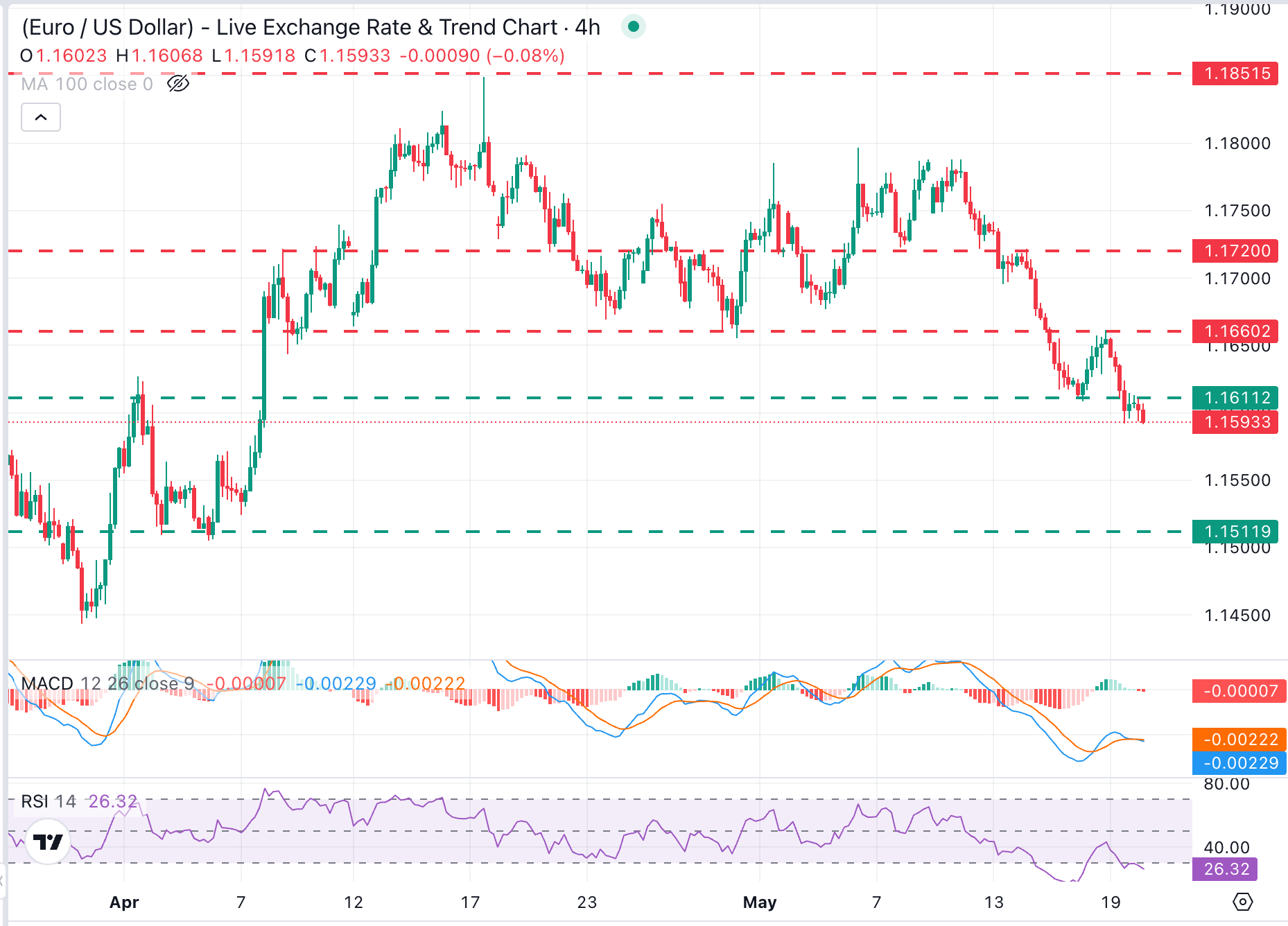
EUR/USD shows a bearish near-term bias after losing about 1.6% in a bit more than a week, with no sign of an upcoming recovery other than a bullish divergence in the 4-hour Relative Strength Index (RSI), which trades near 26, up from heavily oversold levels earlier this week. The Moving Average Convergence Divergence (MACD) histogram hovers around the zero line, suggesting a lack of strong corrective forces for now.
Upside attempts are being limited below Monday's low at the 1.1610 area, which is closing the path towards a support-turned-resistance, roughly between 1.1650 and 1.1670. On the downside, below session lows near 1.1590, there is no clear support area in sight until April's bottom in the 1.1510-1.1525 area.
(The technical analysis of this story was written with the help of an AI tool.)
Economic Indicator
Harmonized Index of Consumer Prices (YoY)
The Harmonized Index of Consumer Prices (HICP) measures changes in the prices of a representative basket of goods and services in the European Monetary Union. The HICP, released by Eurostat on a monthly basis, is harmonized because the same methodology is used across all member states and their contribution is weighted. The YoY reading compares prices in the reference month to a year earlier. Generally, a high reading is seen as bullish for the Euro (EUR), while a low reading is seen as bearish.
Read more.Last release: Wed May 20, 2026 09:00
Frequency: Monthly
Actual: 3%
Consensus: 3%
Previous: 3%
Source: Eurostat
Economic Indicator
Core Harmonized Index of Consumer Prices (YoY)
The Core Harmonized Index of Consumer Prices (HICP) measures changes in the prices of a representative basket of goods and services in the European Monetary Union. The HICP, – released by Eurostat on a monthly basis, is harmonized because the same methodology is used across all member states and their contribution is weighted. The YoY reading compares prices in the reference month to a year earlier. Core HICP excludes volatile components like food, energy, alcohol, and tobacco. The Core HICP is a key indicator to measure inflation and changes in purchasing trends. Generally, a high reading is seen as bullish for the Euro (EUR), while a low reading is seen as bearish.
Read more.Last release: Wed May 20, 2026 09:00
Frequency: Monthly
Actual: 2.2%
Consensus: 2.2%
Previous: 2.2%
Source: Eurostat