
Canada: Unemployment Rate ticked higher to 6.9% in April
- The Unemployment Rate in Canada rose to 6.9%.
- USD/CAD flirts with the 1.3680 zone in the wake of the release.
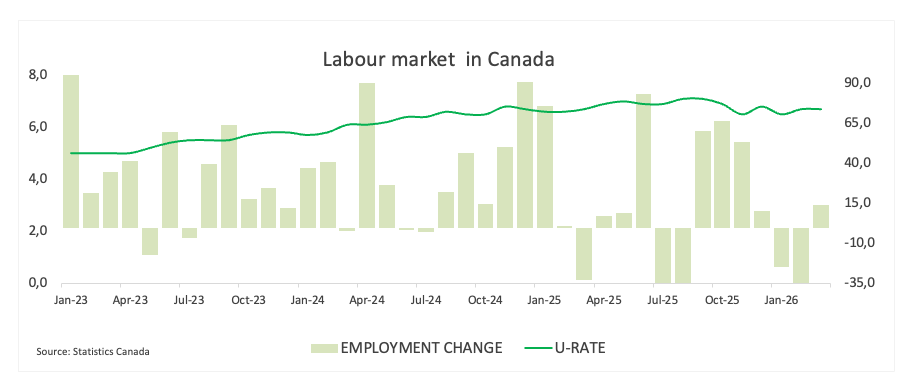
Statistics Canada reported on Friday that the Unemployment Rate climbed to 6.9% in April, surpassing what markets were expecting.
Additionally, the Net Change in Employment decreased by 17.7K jobs, reversing the 14.1K gain we saw in the prior month. In addition, the participation rate rose a tad to 65% and wages are growing at a 4.8% annual pace, down from March’s 5.1% annual gain.
Market reaction
The Canadian Dollar (CAD) maintains a negative bias following the publication of the jobs report on Friday, with USD/CAD navigating below the 1.3700 region, the upper end of its weekly range.
Canadian Dollar Price Today
The table below shows the percentage change of Canadian Dollar (CAD) against listed major currencies today. Canadian Dollar was the strongest against the US Dollar.
| USD | EUR | GBP | JPY | CAD | AUD | NZD | CHF | |
|---|---|---|---|---|---|---|---|---|
| USD | -0.44% | -0.50% | -0.23% | 0.07% | -0.53% | -0.49% | -0.42% | |
| EUR | 0.44% | -0.08% | 0.18% | 0.50% | -0.09% | -0.02% | 0.03% | |
| GBP | 0.50% | 0.08% | 0.28% | 0.58% | -0.02% | 0.06% | 0.11% | |
| JPY | 0.23% | -0.18% | -0.28% | 0.32% | -0.31% | -0.25% | -0.18% | |
| CAD | -0.07% | -0.50% | -0.58% | -0.32% | -0.63% | -0.56% | -0.49% | |
| AUD | 0.53% | 0.09% | 0.02% | 0.31% | 0.63% | 0.07% | 0.13% | |
| NZD | 0.49% | 0.02% | -0.06% | 0.25% | 0.56% | -0.07% | 0.05% | |
| CHF | 0.42% | -0.03% | -0.11% | 0.18% | 0.49% | -0.13% | -0.05% |
The heat map shows percentage changes of major currencies against each other. The base currency is picked from the left column, while the quote currency is picked from the top row. For example, if you pick the Canadian Dollar from the left column and move along the horizontal line to the US Dollar, the percentage change displayed in the box will represent CAD (base)/USD (quote).
This section below was published as a preview of the Canadian labour market report at 08:00 GMT.
- The Canadian Unemployment Rate is seen holding steady in April.
- The BoC is expected to stay put at its June 10 meeting.
- The Canadian Dollar remains on the defensive vs the Greenback this week.
Statistics Canada will release its Labour Force Survey on Friday, and markets are bracing for quite a steady print. The Unemployment Rate is expected to remain at 6.7% in April, while the Employment Change is forecast to increase by 15K following a 14.1K gain in the previous month.
Despite the tone of the report, the bar for a change of direction by the Bank of Canada (BoC) should remain pretty high. Indeed, the central bank is expected to maintain its steady hand at its June 10 gathering, following four consecutive “on hold” decisions.
At its latest event, the BoC signalled an upbeat medium-term outlook for economic growth while revising inflation higher for the current year. In addition, Governor Tiff Macklem delivered a cautious message at his press conference, keeping the data-dependent stance well in place while leaving the door open to higher rates in case energy prices remain elevated.
So far, market participants expect around 45 basis points of tightening by the bank by year-end.
What can we expect from the next Canadian Unemployment Rate print?
Consensus among analysts sees Canada’s Unemployment Rate at 6.7% last month. Additionally, investors forecast the economy will add around 15K jobs in April, a tad higher than March’s 14.1K gain. It is worth recalling that Average Hourly Wages rose at an annualised 5.1% in March (from 4.9%), pointing to sticky wage inflation.
When is the Canada Unemployment Rate released, and how could it affect USD/CAD?
All eyes in Canada will be on Friday’s release of the jobs report, due at 12:30 GMT. A stronger print could give the Canadian Dollar (CAD) a quick lift, but don’t expect fireworks.
USD/CAD has been on a steady uptrend this week, almost entirely to the tune of developments from the Middle East and dynamics around the US Dollar (USD).
Pablo Piovano, Senior Analyst at FXStreet, points out that USD/CAD has been edging higher in the last few days, reclaiming the 1.3600 barrier and approaching 1.3650. Further up comes the weekly top at 1.3714 (April 24), an area reinforced by the provisional 55-day and 100-day SMAs around 1.3720. Further north emerges the always relevant 200-day SMA near 1.3815.
On the flip side, he highlights initial support at the May floor of 1.3549 (May 1), seconded by the March base at 1.3525 (March 9), the February valley at 1.3504 (February 11) and the 2026 bottom at 1.3481 (January 30).
“Momentum favours extra declines,” he adds, noting that the Relative Strength Index (RSI) is hovering near 43 and the Average Directional Index (ADX) just over 24 suggests the underlying trend appears to be gathering traction.
Economic Indicator
Unemployment Rate
The Unemployment Rate, released by Statistics Canada, is the number of unemployed workers divided by the total civilian labor force as a percentage. It is a leading indicator for the Canadian Economy. If the rate is up, it indicates a lack of expansion within the Canadian labor market and a weakening of the Canadian economy. Generally, a decrease of the figure is seen as bullish for the Canadian Dollar (CAD), while an increase is seen as bearish.
Read more.Next release: Fri May 08, 2026 12:30
Frequency: Monthly
Consensus: 6.7%
Previous: 6.7%
Source: Statistics Canada
Economic Indicator
BoC Interest Rate Decision
The Bank of Canada (BoC) announces its interest rate decision at the end of its eight scheduled meetings per year. If the BoC believes inflation will be above target (hawkish), it will raise interest rates in order to bring it down. This is bullish for the CAD since higher interest rates attract greater inflows of foreign capital. Likewise, if the BoC sees inflation falling below target (dovish) it will lower interest rates in order to give the Canadian economy a boost in the hope inflation will rise back up. This is bearish for CAD since it detracts from foreign capital flowing into the country.
Read more.Last release: Wed Apr 29, 2026 13:45
Frequency: Irregular
Actual: 2.25%
Consensus: 2.25%
Previous: 2.25%
Source: Bank of Canada