
Breaking: BoC leaves interest rate unchanged at 2.25%
As widely anticipated, the Bank of Canada (BoC) left its policy rate unchanged at 2.25% on Wednesday. The focus now turns to Governor Tiff Macklem’s press conference at 14:30 GMT, where markets will be looking for further insight into today’s decision and clearer guidance on the policy outlook.
This section below was published as a preview of the Bank of Canada's (BoC) monetary policy announcements at 09:00 GMT.
- The Bank of Canada is expected to keep its interest rate at 2.25%.
- The Canadian Dollar remains weak, with USD/CAD above 1.3700.
- Markets pencil in around 10 bps of hiking by the BoC this year.
The Bank of Canada (BoC) is widely expected to keep its policy rate unchanged at 2.25% at its Wednesday meeting, effectively extending the pause it signalled back in January.
At that meeting, policymakers did exactly that, leaving the policy rate at 2.25%, broadly in line with market expectations. The decision reinforced the bank’s cautious, wait-and-see approach as officials continue to navigate a rather uncertain global backdrop amid the US-Iran war and the Oil supply disruptions through the Strait of Hormuz.
While higher crude prices could add to inflation risks, Canada is also a major Oil exporter, meaning stronger energy prices may support economic growth.
The updated projections also paint a somewhat softer picture for the economy. The economy is still projected to expand, with GDP rising by roughly 1.1% anticipated for 2026. However, the trajectory of that growth appears less robust.
In fact, the bank now sees activity losing momentum toward the end of the forecast horizon, with growth expected to be flat in the fourth quarter.
The inflation picture is looking a bit brighter, as the Consumer Price Index (CPI) is projected to average roughly 2% this year. Furthermore, this slight dip indicates that inflationary pressures are moving toward the bank's target.
In addition, policymakers kept their estimate of the neutral rate unchanged in the 2.25%-3.25% range.
In his previous press conference, Governor Tiff Macklem cautioned that the changes to US tariffs might be permanent, even hinting that the period of unrestricted, rules-based trade between Canada and the US could be over.
Overall, the BoC’s message is clear: officials appear satisfied with maintaining interest rates at their current levels, at least for now, while closely monitoring the economy's slower growth and the unpredictable global situation.
Inflation, however, remains the key watch point after the headline CPI edged up to 1.8% YoY in February, falling below the bank’s target for the first time since August 2025. In the same direction, the core inflation eased to 2.3% from a year earlier. The bank’s preferred measures, CPI-Common, Trimmed and Median, also ticked lower, but at 2.4%, 2.3% and 2.3%, respectively, they remain comfortably above target.
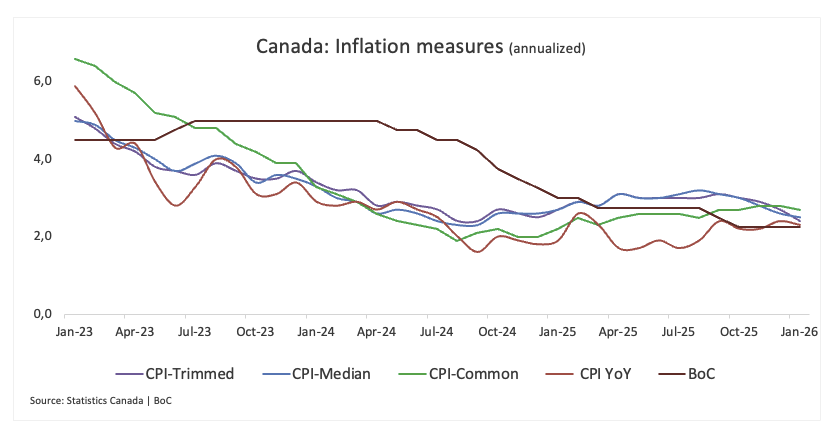
Previewing the BoC’s interest rate decision, strategists Molly Schwartz and Christian Lawrence at Rabobank noted, “We expect the Bank of Canada to maintain the overnight policy rate at 2.25% through year-end; however, the market is starting to price the possibility of a hike into the OIS curve.”
When will the BoC release its monetary policy decision, and how could it affect USD/CAD?
The Bank of Canada will announce its policy decision on Wednesday at 13:45 GMT, followed by a press conference with Governor Tiff Macklem at 14:30 GMT.
Markets anticipate the central bank to maintain its current stance, with a projected tightening of approximately 42 basis points by the end of 2026.
Pablo Piovano, Senior Analyst at FXStreet, points out that the Canadian Dollar (CAD) has been depreciating steadily against the Greenback since its monthly troughs in the low 1.3500s, finding some decent resistance around 1.3750 in the last few days.
Piovano says a return of a more convincing bullish momentum could prompt spot to initially reclaim the March top at 1.3752 (March 3), ahead of its key 200-day SMA at 1.3798 and the 2026 ceiling at 1.3928 (January 16). Up from here comes the key 1.4000 threshold, seconded by the November top at 1.4140 (November 5).
On the downside, he adds, "The loss of the March base at 1.3525 (March 9) could put a test of the February valley at 1.3504 (February 11) back into view ahead of the 2026 bottom at 1.3481 (January 30).
“Momentum favours extra gains,” he suggests, noting that the Relative Strength Index (RSI) hovers near the 54 level, although the Average Directional Index (ADX) around 14 is indicative of a pale trend.
Bank of Canada FAQs
The Bank of Canada (BoC), based in Ottawa, is the institution that sets interest rates and manages monetary policy for Canada. It does so at eight scheduled meetings a year and ad hoc emergency meetings that are held as required. The BoC primary mandate is to maintain price stability, which means keeping inflation at between 1-3%. Its main tool for achieving this is by raising or lowering interest rates. Relatively high interest rates will usually result in a stronger Canadian Dollar (CAD) and vice versa. Other tools used include quantitative easing and tightening.
In extreme situations, the Bank of Canada can enact a policy tool called Quantitative Easing. QE is the process by which the BoC prints Canadian Dollars for the purpose of buying assets – usually government or corporate bonds – from financial institutions. QE usually results in a weaker CAD. QE is a last resort when simply lowering interest rates is unlikely to achieve the objective of price stability. The Bank of Canada used the measure during the Great Financial Crisis of 2009-11 when credit froze after banks lost faith in each other’s ability to repay debts.
Quantitative tightening (QT) is the reverse of QE. It is undertaken after QE when an economic recovery is underway and inflation starts rising. Whilst in QE the Bank of Canada purchases government and corporate bonds from financial institutions to provide them with liquidity, in QT the BoC stops buying more assets, and stops reinvesting the principal maturing on the bonds it already holds. It is usually positive (or bullish) for the Canadian Dollar.
Interest rates FAQs
Interest rates are charged by financial institutions on loans to borrowers and are paid as interest to savers and depositors. They are influenced by base lending rates, which are set by central banks in response to changes in the economy. Central banks normally have a mandate to ensure price stability, which in most cases means targeting a core inflation rate of around 2%. If inflation falls below target the central bank may cut base lending rates, with a view to stimulating lending and boosting the economy. If inflation rises substantially above 2% it normally results in the central bank raising base lending rates in an attempt to lower inflation.
Higher interest rates generally help strengthen a country’s currency as they make it a more attractive place for global investors to park their money.
Higher interest rates overall weigh on the price of Gold because they increase the opportunity cost of holding Gold instead of investing in an interest-bearing asset or placing cash in the bank. If interest rates are high that usually pushes up the price of the US Dollar (USD), and since Gold is priced in Dollars, this has the effect of lowering the price of Gold.
The Fed funds rate is the overnight rate at which US banks lend to each other. It is the oft-quoted headline rate set by the Federal Reserve at its FOMC meetings. It is set as a range, for example 4.75%-5.00%, though the upper limit (in that case 5.00%) is the quoted figure. Market expectations for future Fed funds rate are tracked by the CME FedWatch tool, which shapes how many financial markets behave in anticipation of future Federal Reserve monetary policy decisions.