
BoC expected to keep interest rate unchanged as prices stay elevated and growth slows
- The Bank of Canada is expected to keep its interest rate at 2.25%.
- The Canadian Dollar remains weak, with USD/CAD near 1.4000.
- Markets pencil in around 36 bps of hiking by the BoC this year.
The Bank of Canada (BoC) is widely expected to keep its policy rate unchanged at 2.25% on Wednesday. This would be the fifth consecutive gathering with the bank keeping its hand steady.
At its April event, the BoC left rates unchanged at 2.25%, as expected, but the overall message was far from dovish.
While policymakers see some softness in near-term growth, inflation is proving a little more stubborn than anticipated, with wage growth still running in the 3% to 3.5% range. In other words, the economy is slowing, but not enough to completely remove inflation concerns.
Governor Tiff Macklem reiterated that there is no preset path for rates and stressed that policymakers remain guided by incoming data. Importantly, he refused to rule out further tightening, noting that persistently high energy prices could eventually require a policy response. At the same time, he said, existing economic slack should help to contain the inflationary impact of higher energy prices.
Macklem also warned that inflation expectations may be less firmly anchored than they were before the pandemic, while Deputy Governor Carolyn Rogers highlighted trade tensions as a longer-term risk to the outlook.
All in all, the bank remains firmly in wait-and-see mode, but it is not signalling rate cuts anytime soon. Inflation risks still lean modestly to the upside, allowing for further tightening if price pressures prove more persistent than expected.
Inflation, however, remains the key watch point after the headline CPI rose by 2% in the year to April, below the previous month’s print of 2.2% and matching the bank’s target. In the same direction, the BoC’s core inflation eased to 2.1% from a year earlier. The bank’s preferred measures, CPI-Common, Trimmed and Median, also ticked lower, but at 2.5%, 2% and 2.1%, respectively, they still remain above target.
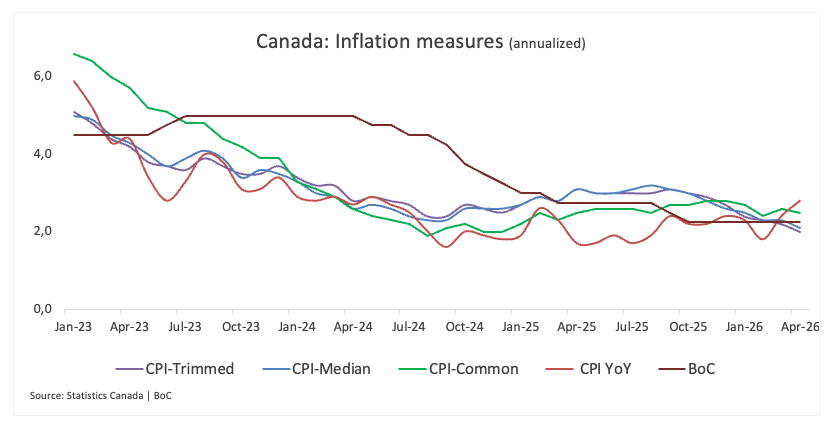
When will the BoC release its monetary policy decision, and how could it affect USD/CAD?
The Bank of Canada will announce its policy decision on Wednesday at 13:45 GMT, followed by a press conference with Governor Tiff Macklem at 14:30 GMT.
Markets anticipate the central bank maintaining its current stance, with a projected tightening of just over 35 basis points by the end of 2026.
Pablo Piovano, Senior Analyst at FXStreet, points out that the Canadian Dollar (CAD) has been depreciating steadily against the Greenback since May, lifting USD/CAD to an area close to the psychological 1.4000 barrier earlier this week.
Piovano says the continuation of the ongoing bullish momentum could prompt the spot to initially reclaim the 2026 ceiling at 1.3966 (March 31). Up from here comes the key 1.4000 threshold, seconded by the November top at 1.4140 (November 5).
On the downside, he adds, "The loss of the 200-day SMA at 1.3813 could pave the way for extra weakness, targeting the weekly floor at 1.3770, which appears reinforced by the provisional 55-day SMA. Down from here emerges the May base at 1.3949 (May 29), ahead of the March trough at 1.3525 (March 9) and the February valley at 1.3504 (February 11).
“Momentum favours extra gains,” he suggests, noting that the Relative Strength Index (RSI) hovers near the 68 level, while the Average Directional Index (ADX) just past 30 is indicative of a strong trend.
Economic Indicator
BoC Interest Rate Decision
The Bank of Canada (BoC) announces its interest rate decision at the end of its eight scheduled meetings per year. If the BoC believes inflation will be above target (hawkish), it will raise interest rates in order to bring it down. This is bullish for the CAD since higher interest rates attract greater inflows of foreign capital. Likewise, if the BoC sees inflation falling below target (dovish) it will lower interest rates in order to give the Canadian economy a boost in the hope inflation will rise back up. This is bearish for CAD since it detracts from foreign capital flowing into the country.
Read more.Next release: Wed Jun 10, 2026 13:45
Frequency: Irregular
Consensus: 2.25%
Previous: 2.25%
Source: Bank of Canada
Canadian Dollar FAQs
The key factors driving the Canadian Dollar (CAD) are the level of interest rates set by the Bank of Canada (BoC), the price of Oil, Canada’s largest export, the health of its economy, inflation and the Trade Balance, which is the difference between the value of Canada’s exports versus its imports. Other factors include market sentiment – whether investors are taking on more risky assets (risk-on) or seeking safe-havens (risk-off) – with risk-on being CAD-positive. As its largest trading partner, the health of the US economy is also a key factor influencing the Canadian Dollar.
The Bank of Canada (BoC) has a significant influence on the Canadian Dollar by setting the level of interest rates that banks can lend to one another. This influences the level of interest rates for everyone. The main goal of the BoC is to maintain inflation at 1-3% by adjusting interest rates up or down. Relatively higher interest rates tend to be positive for the CAD. The Bank of Canada can also use quantitative easing and tightening to influence credit conditions, with the former CAD-negative and the latter CAD-positive.
The price of Oil is a key factor impacting the value of the Canadian Dollar. Petroleum is Canada’s biggest export, so Oil price tends to have an immediate impact on the CAD value. Generally, if Oil price rises CAD also goes up, as aggregate demand for the currency increases. The opposite is the case if the price of Oil falls. Higher Oil prices also tend to result in a greater likelihood of a positive Trade Balance, which is also supportive of the CAD.
While inflation had always traditionally been thought of as a negative factor for a currency since it lowers the value of money, the opposite has actually been the case in modern times with the relaxation of cross-border capital controls. Higher inflation tends to lead central banks to put up interest rates which attracts more capital inflows from global investors seeking a lucrative place to keep their money. This increases demand for the local currency, which in Canada’s case is the Canadian Dollar.
Macroeconomic data releases gauge the health of the economy and can have an impact on the Canadian Dollar. Indicators such as GDP, Manufacturing and Services PMIs, employment, and consumer sentiment surveys can all influence the direction of the CAD. A strong economy is good for the Canadian Dollar. Not only does it attract more foreign investment but it may encourage the Bank of Canada to put up interest rates, leading to a stronger currency. If economic data is weak, however, the CAD is likely to fall.