
AUD/USD Price Forecast: Aussie rejected at 0.7100, upside risks persist
- Risk mood improves as DXY hits four-week lows near 98.52.
- Weekend US-Iran talks seen as catalyst for AUD/USD above 0.7100.
- Upside capped below 0.7100; support seen at 0.7026, 0.6978.
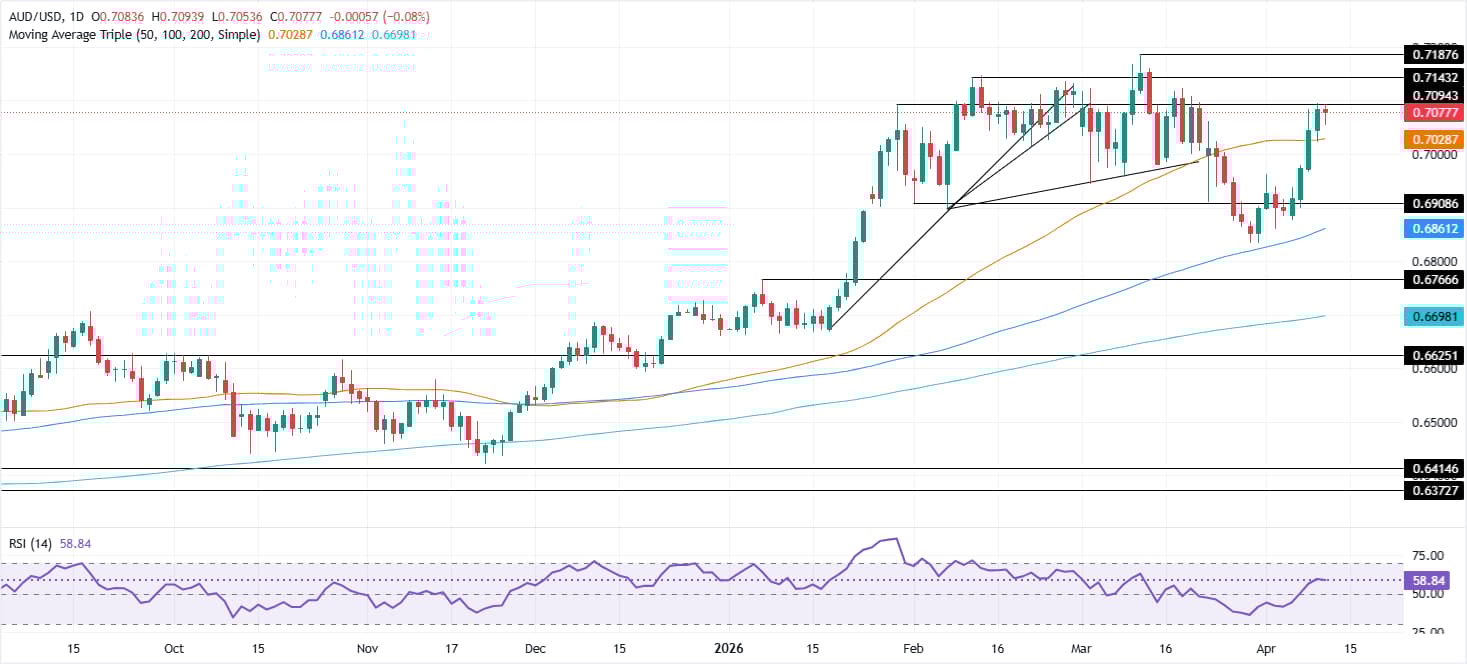
The Australian Dollar (AUD) is poised to end Friday’s session flat against the US Dollar (USD), even though an improvement in market mood drove the Greenback toward four-week lows near 98.52, according to the US Dollar Index (DXY). Hopes that the US-Iran talks over the weekend could open the door for further discussions to lay a deal may push AUD/USD higher, past 0.7100, clearing key resistance at Thursday's high of 0.7094. At the time of writing, the pair trades around 0.7070.
AUD/USD Price Forecast: Technical Outlook
On its way north, AUD/USD cleared April’s 1 high past 0.6962, but fell shy of cracking the 20-day Simple Moving Average (SMA). Finally, on Tuesday, buyers reclaimed 0.6978 —the 20-day SMA—and crushed 0.7000 as the pair was on its way toward weekly highs reached the next day.
Despite this, buyers ran out of steam and failed to overcome the 0.7100 figure, which is seen as the next key resistance level, before traders aim towards the March 11 year-to-date (YTD) high at 0.7187. On further strength, 0.7200 is up next.
On the downside, AUD/USD must drop below the 50-day SMA at 0.7026, so traders can remain hopeful of challenging 0.7000. On further weakness, the next stop would be the 20-day SMA at 0.6978, followed by the April 6 swing low of 0.6875.
AUD/USD Price Chart – Daily
Australian Dollar FAQs
One of the most significant factors for the Australian Dollar (AUD) is the level of interest rates set by the Reserve Bank of Australia (RBA). Because Australia is a resource-rich country another key driver is the price of its biggest export, Iron Ore. The health of the Chinese economy, its largest trading partner, is a factor, as well as inflation in Australia, its growth rate and Trade Balance. Market sentiment – whether investors are taking on more risky assets (risk-on) or seeking safe-havens (risk-off) – is also a factor, with risk-on positive for AUD.
The Reserve Bank of Australia (RBA) influences the Australian Dollar (AUD) by setting the level of interest rates that Australian banks can lend to each other. This influences the level of interest rates in the economy as a whole. The main goal of the RBA is to maintain a stable inflation rate of 2-3% by adjusting interest rates up or down. Relatively high interest rates compared to other major central banks support the AUD, and the opposite for relatively low. The RBA can also use quantitative easing and tightening to influence credit conditions, with the former AUD-negative and the latter AUD-positive.
China is Australia’s largest trading partner so the health of the Chinese economy is a major influence on the value of the Australian Dollar (AUD). When the Chinese economy is doing well it purchases more raw materials, goods and services from Australia, lifting demand for the AUD, and pushing up its value. The opposite is the case when the Chinese economy is not growing as fast as expected. Positive or negative surprises in Chinese growth data, therefore, often have a direct impact on the Australian Dollar and its pairs.
Iron Ore is Australia’s largest export, accounting for $118 billion a year according to data from 2021, with China as its primary destination. The price of Iron Ore, therefore, can be a driver of the Australian Dollar. Generally, if the price of Iron Ore rises, AUD also goes up, as aggregate demand for the currency increases. The opposite is the case if the price of Iron Ore falls. Higher Iron Ore prices also tend to result in a greater likelihood of a positive Trade Balance for Australia, which is also positive of the AUD.
The Trade Balance, which is the difference between what a country earns from its exports versus what it pays for its imports, is another factor that can influence the value of the Australian Dollar. If Australia produces highly sought after exports, then its currency will gain in value purely from the surplus demand created from foreign buyers seeking to purchase its exports versus what it spends to purchase imports. Therefore, a positive net Trade Balance strengthens the AUD, with the opposite effect if the Trade Balance is negative.